Dubai websites in Arabic and English built for UAE rules

Dubai
Delivered remotely from Islamabad, Pakistan
Who commissions web work in Dubai
Dubai's economy leans on trade. In Dubai government figures for the first nine months of 2025, wholesale and retail trade was the largest single contributor to GDP, followed by financial and insurance services, real estate, construction, and information and communications. For a web agency those sectors turn into recognisable briefs: developers and brokerages launching projects, retailers selling online, trading and logistics firms that need portals, and finance and advisory firms whose website is part of the due-diligence check a counterparty runs.
The audience is unusually mixed. Arabic is the UAE's official language, English is the most used language in business, and large communities speak Malayalam, Hindi, Urdu, Tagalog and other languages. A good Dubai brief decides early which audience each page is for, instead of translating everything line by line in the final week. Payment data for the UAE shows more than 60 percent of online purchases are made on a mobile device, so the mobile layout in both languages is the primary design, not an adaptation of the desktop one.
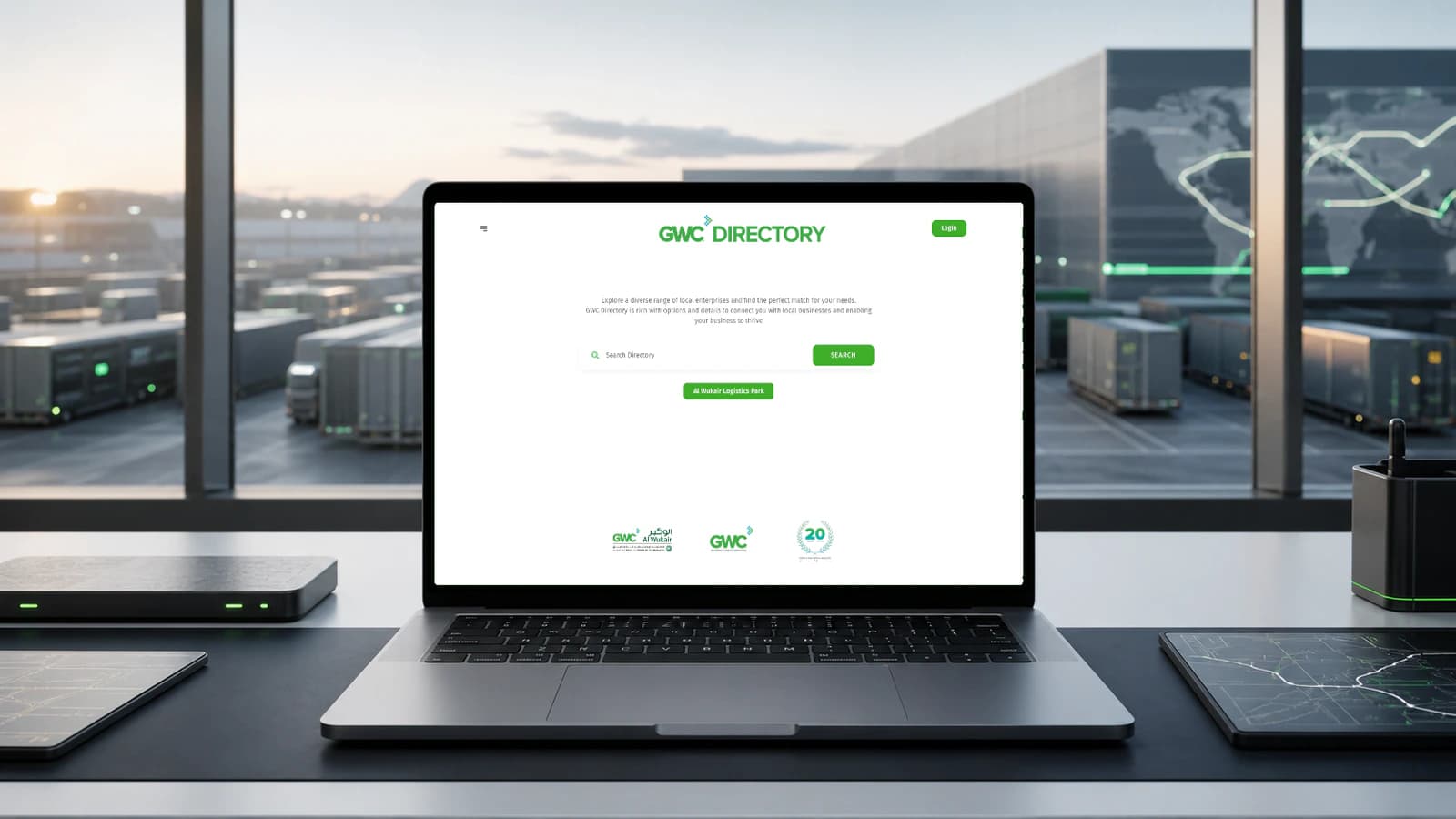
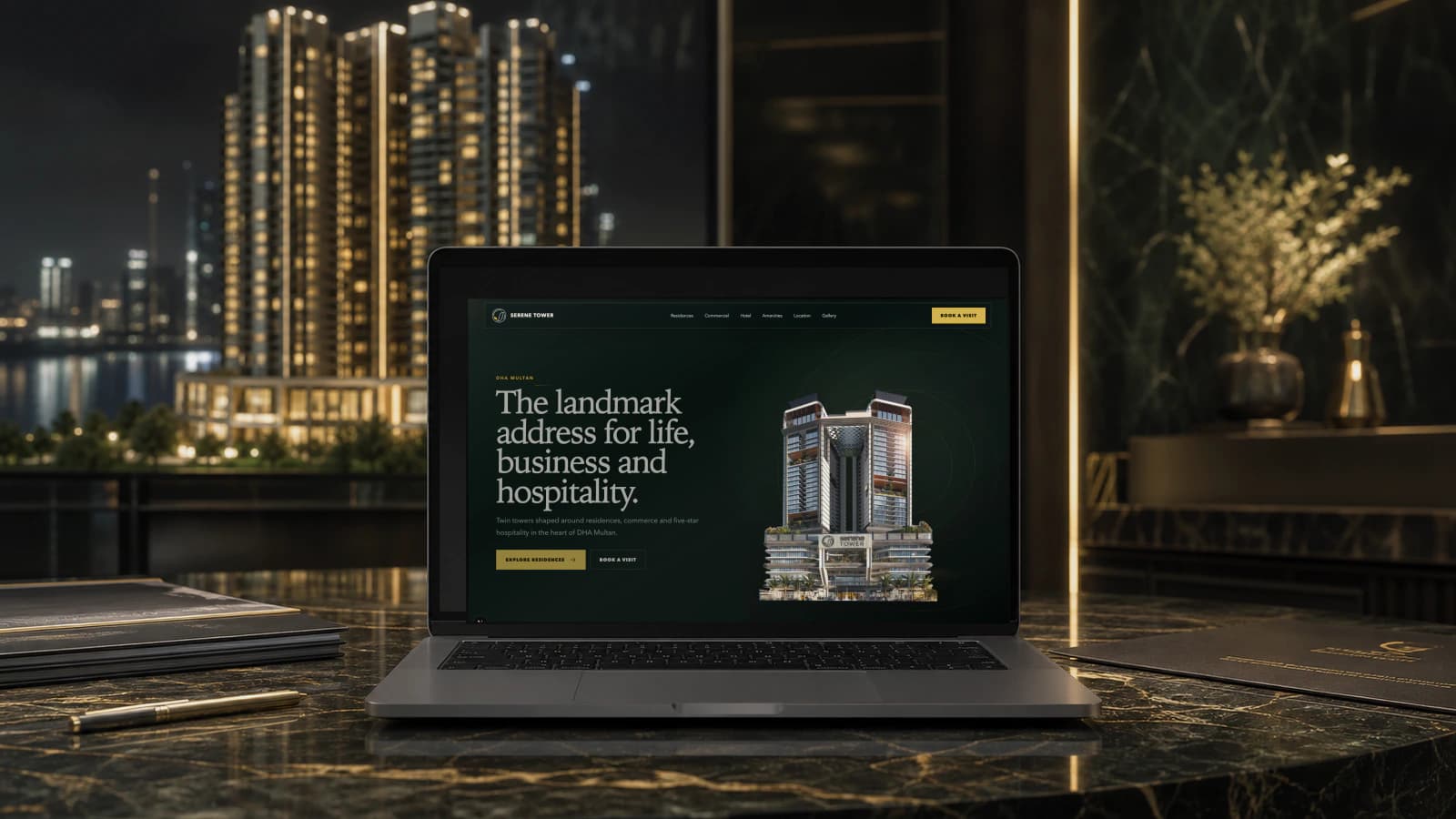
Our closest proof comes from the Gulf and from property. In Qatar we built The Closet, a fashion storefront shaped around product discovery and a short path to purchase, and GWC Directory, a platform that makes a large logistics ecosystem searchable. Our real estate launch sites, including Serene Tower in DHA Multan and 360 The Residences, were built for developers in Pakistan. A Dubai launch uses the same patterns: construction storytelling, unit journeys and enquiry routing.
Arabic is part of the build
For consumer sales, Arabic is a legal requirement as well as a marketing choice. The executive regulations of the UAE Consumer Protection Law took effect on 14 October 2023. Under them, advertising, contracts, invoices and the information e-commerce providers display on their websites must be in Arabic as a minimum, with other languages allowed alongside it. An English-only storefront selling to UAE consumers carries a risk that is easy to avoid.
We deliver Arabic and multilingual websites. The right-to-left layout is mirrored properly, including navigation, icons, sliders, form fields and checkout steps, rather than being an English template with Arabic text poured in. We pair Arabic and Latin typefaces so both languages carry the same visual weight, give each language its own URLs and hreflang tags so search engines show the right version, and set up the CMS so your team can edit both languages without touching code.
Some of the Arabic will be legal text, such as returns policies, terms or product warnings. We recommend that your legal adviser signs that text off before launch, and we structure the site so the sign-off is a content step rather than a redevelopment.
Prices, payments and invoices
VAT-registered businesses must display prices inclusive of VAT, and the Federal Tax Authority has described tax-exclusive consumer prices as misleading. The administrative penalty for failing to display tax-inclusive prices is AED 5,000. We set up storefronts to show VAT-inclusive AED prices on product, cart and checkout pages, and we check that the price a customer sees is the price the invoice charges. On a trade portal selling to VAT-registered buyers, prices may be shown excluding VAT if they are clearly marked, so we label them that way.
UAE shoppers pay in more ways than cards. PPRO's market data notes that they use cash and digital methods rather than cards for almost half of e-commerce purchases. The Central Bank has regulated buy now, pay later providers since December 2023, and Tamara received a restricted finance licence from it in October 2025. Jaywan, the national card scheme launched in 2024, is accepted on e-commerce platforms. We choose a payment gateway that covers the methods your customers use. Cash on delivery is more than a checkout setting: it is a decision about couriers, returns and failed deliveries.
The UAE's e-invoicing system covers business-to-business and business-to-government transactions; consumer sales are excluded. Businesses with revenue of AED 50 million or more must appoint an accredited service provider by 30 October 2026 and go live on 1 January 2027. Smaller businesses go live on 1 July 2027. If your site runs trade accounts, wholesale ordering or a supplier portal, we keep invoice issuing out of the website: the order flow passes clean data to your ERP and your service provider, which issue the e-invoice.
Property permits, privacy and access
Real estate companies in Dubai must obtain a Dubai Land Department (DLD) permit, through its Trakheesi system, before publishing a property advertisement, and the permit number belongs in the ad. The permit covers electronic advertising as well as print and outdoor. Since April 2023, real estate companies have been expected to carry the Madmoun QR code on print and audiovisual ads so buyers can check them against DLD records. On developer and brokerage sites we build project and listing templates with fields for the permit number and QR code, so your marketing team can publish pages that show both without waiting for a developer.
Companies on the Dubai mainland and in most free zones fall under the federal Personal Data Protection Law, in force since January 2022. It makes consent the default basis for processing personal data, with listed exceptions, and sets conditions for sending data abroad. Companies incorporated in the Dubai International Financial Centre (DIFC) follow the DIFC Data Protection Law instead, and since July 2025 that law has let individuals take damages claims to court without first going to the Commissioner. We map every form, cookie and integration on the site: where an enquiry is stored, which CRM receives it and which country the server sits in. The privacy notice your adviser writes can then describe what the site really does.
On accessibility, the UAE has set a clear public benchmark. The National Digital Accessibility Policy guides federal government entities to WCAG 2.1 AA. Dubai's 2022 law on the rights of people with disabilities requires government entities to provide information in accessible formats and tasks its higher committee with building partnerships with the private sector. Both are aimed at government services, but WCAG 2.1 AA is a sensible standard for a private site too, and we use it as our working checklist: sufficient contrast, keyboard access, labelled forms, and readable text sizes in Arabic and English.
Working across time zones.
Islamabad is one hour ahead of Dubai all year, so we schedule calls and reviews inside your office hours.
Dubai keeps Gulf Standard Time (UTC+4) all year and Islamabad keeps Pakistan Standard Time (UTC+5). Neither observes daylight saving, so the gap never changes: Islamabad is exactly one hour ahead. A 9:00 to 18:00 Dubai day runs from 10:00 to 19:00 in Islamabad, so a 10:00 Dubai review is at 11:00 in Islamabad and a 17:00 Dubai sign-off call is at 18:00. Since January 2022, federal government entities have worked Monday to Friday noon, while private companies choose their own days off. We confirm your team's working days at kickoff and avoid Friday afternoon reviews unless you prefer them.
What a build in Dubai needs.
Arabic on consumer-facing pages
The executive regulations of the Consumer Protection Law require advertising, contracts, invoices and the website information shown by e-commerce providers to be in Arabic as a minimum, with other languages allowed alongside it. We deliver Arabic and multilingual sites with mirrored right-to-left layouts, paired Arabic and Latin type, separate language URLs with hreflang tags, and a CMS your team can edit in both languages.
Federal PDPL or DIFC data protection
Mainland and most free-zone companies follow the federal Personal Data Protection Law, where consent is the default basis for processing, with listed exceptions, and sending data abroad needs a lawful route. Entities incorporated in DIFC follow DIFC's own Data Protection Law. We document every form, cookie, integration and hosting location so that your privacy notice and consent handling match what was built.
VAT-inclusive AED pricing
VAT-registered businesses must display VAT-inclusive prices, and failing to do so carries an AED 5,000 administrative penalty. We set storefronts to show VAT-inclusive AED prices from product page to checkout, clearly label any VAT-exclusive trade prices shown to registered buyers, and check displayed prices against the invoice output before launch.
Trakheesi permits on property pages
Real estate companies must obtain a Dubai Land Department permit through Trakheesi before publishing a property ad, and the permit number belongs in the ad. Since April 2023, companies have been expected to carry the Madmoun QR code on print and audiovisual ads. We add fields for the permit number and QR code to project and listing templates, so your marketing team can publish pages that display them.
E-invoicing for B2B order flows
Mandatory e-invoicing covers business-to-business and business-to-government transactions, and consumer sales are excluded. It starts on 1 January 2027 for businesses with revenue of AED 50 million or more, which must appoint an accredited service provider by 30 October 2026, and on 1 July 2027 for smaller businesses. If your site takes trade or wholesale orders, we design how order data passes to your ERP and accredited service provider.
What Xsofty can build for Dubai clients.
Web Design & Development
High-performance websites shaped around your brand, your audience, and the outcomes that matter.
- Strategy
- Next.js
- CMS
Arabic & Multilingual Websites
Right-to-left Arabic layouts and bilingual websites, planned for reading and for search in each language.
- Arabic RTL
- Bilingual
- hreflang
E-Commerce Development
Fast, frictionless storefronts that turn discovery into purchase across every screen.
- Shopify
- WooCommerce
- Conversion
Brand & UI/UX Design
Distinct identities and intuitive digital systems that make every interaction feel unmistakably yours.
- Identity
- Research
- Design systems
Custom Web Apps & AI Integrations
Purpose-built platforms and useful AI workflows that remove friction from complex operations.
- Web apps
- Automation
- AI
SEO & Digital Growth
Search foundations, content direction, and measurable improvements designed to compound over time.
- Technical SEO
- Content
- Analytics
Who we build for in Dubai.
Real estate developers and brokerages
Launch sites that tell the project story, unit and listing templates with fields for Trakheesi permit numbers and Madmoun QR codes, and bilingual enquiry forms that send leads to the sales CRM without delay.
Retail, fashion and consumer brands
Arabic and English storefronts with VAT-inclusive AED pricing, payment options beyond cards, and product discovery designed for mobile first.
Trading, logistics and free-zone companies
Directories, supplier portals and B2B ordering that stay easy to search as listings grow, with clearly marked trade pricing and order data structured to feed e-invoicing.
Financial and professional services
Restrained, credible sites that hold up to due diligence, with consent-aware forms set up for the federal PDPL or the DIFC Data Protection Law.
Architecture, interiors and construction
Image-led sites that present projects as evidence, with a clear service structure and galleries that load quickly on mobile.
Hospitality and experiences
Mobile-first sites that take visitors to booking, menus or directions quickly, in the languages your guests use.
Relevant work
Recent Gulf work includes three Qatar projects, The Closet, GWC Directory and BEAT; our property launch sites were built for developers in Pakistan.


Questions from Dubai clients.
No. Xsofty is based in Islamabad and works with Dubai businesses remotely. Islamabad is one hour ahead of Dubai all year, so discovery calls, design reviews and launch checks happen during your working day. We write up the decisions after each call.
More in United Arab Emirates
Sources for this page (26)
- Wholesale and retail trade was the largest contributor to Dubai's GDP in the first nine months of 2025 (25.9%), followed by financial and insurance, real estate, construction and ICT dmo.dof.gov.ae (opens in a new tab)
- Arabic is the UAE's official language; English is the most used language in business; Malayalam, Tagalog, Hindi, Urdu and others are widely spoken en.wikipedia.org (opens in a new tab)
- More than 60% of UAE online purchases are made on a mobile device; shoppers use cash and digital methods rather than cards for almost half of e-commerce purchases; cards (52%) are the largest single method ppro.com (opens in a new tab)
- Consumer Protection Law executive regulations require advertising, contracts, website information of e-commerce providers and invoices to be in Arabic as a minimum, with other languages allowed; effective 14 October 2023 pinsentmasons.com (opens in a new tab)
- Goods and services must be advertised in Arabic; the regime extends to e-commerce providers; invoices in Arabic with prices in local currency hlc.com (opens in a new tab)
- Cabinet Resolution No. 66 of 2023 (Consumer Protection executive regulations) took effect on 14 October 2023 afridi-angell.com (opens in a new tab)
- FTA requires VAT-registered businesses to display VAT-inclusive prices and described tax-exclusive display as misleading consumers khaleejtimes.com (opens in a new tab)
- Administrative penalty for failure of the taxable person to display prices inclusive of tax is AED 5,000 (Cabinet Decision No. 49 of 2021) tax.gov.ae (opens in a new tab)
- Cabinet Decision No. 129 of 2025 (effective 14 April 2026) made no significant change to the penalty for displaying prices including tax ae.andersen.com (opens in a new tab)
- VAT-inclusive display rule (Article 38 VAT Decree-Law); prices for sales to VAT-registered businesses may be shown VAT-exclusive if clearly marked; penalty reduced from AED 15,000 to AED 5,000 habibalmulla.com (opens in a new tab)
- CBUAE has regulated BNPL providers since December 2023 under the Finance Companies Regulation grantthornton.co.uk (opens in a new tab)
- Tamara secured a restricted finance licence from the Central Bank of the UAE (announced 20 October 2025) thepaypers.com (opens in a new tab)
- Jaywan, the UAE's national domestic card scheme launched in 2024 and operated by a CBUAE subsidiary, is accepted on e-commerce platforms thenationalnews.com (opens in a new tab)
- UAE e-invoicing covers B2B and B2G, excludes B2C; mandatory from 1 January 2027 for revenue of AED 50m or more and 1 July 2027 for smaller businesses kpmg.com (opens in a new tab)
- Deadline to appoint an e-invoicing accredited service provider extended to 30 October 2026 for businesses over AED 50m; go-live remains 1 January 2027 (announced 10 May 2026) mof.gov.ae (opens in a new tab)
- DLD Real Estate Ad Permit, applied for through Trakheesi, covers electronic, printed, outdoor and other advertisement types dubailand.gov.ae (opens in a new tab)
- Real estate companies wishing to publish any real estate advertisement in Dubai must apply for a permit through Trakheesi, and the permit number must be placed in the advertisement dubailand.gov.ae (opens in a new tab)
- Since 24 April 2023, real estate companies are expected to carry the Madmoun QR code on print and audiovisual ads so customers can verify them dubailand.gov.ae (opens in a new tab)
- UAE PDPL in force since 2 January 2022; personal data may be processed only with consent except in listed cases; free-zone entities with their own data protection laws such as DIFC are excluded; conditions apply to cross-border transfers securiti.ai (opens in a new tab)
- PDPL cross-border transfer conditions (Articles 22 and 23) trade.gov (opens in a new tab)
- DIFC Data Protection Law applies to DIFC-incorporated entities; amendments effective 8 July 2025 let data subjects bring court claims for damages without first complaining to the Commissioner dlapiper.com (opens in a new tab)
- UAE National Digital Accessibility Policy guides federal government entities to WCAG 2.1 AA tdra.gov.ae (opens in a new tab)
- Dubai Law No. 3 of 2022 requires government entities (Concerned Entities) to provide information in accessible formats (Art. 5) and directs the Higher Committee to build partnerships with the private sector (Art. 6) dlp.dubai.gov.ae (opens in a new tab)
- UAE uses Gulf Standard Time, UTC+4, year-round with no daylight saving en.wikipedia.org (opens in a new tab)
- Pakistan Standard Time is UTC+5 and daylight saving is not currently observed (last used 2009) en.wikipedia.org (opens in a new tab)
- From January 2022 federal government entities moved to a Monday to Friday-noon week; private companies choose their own off days khaleejtimes.com (opens in a new tab)