Web design for the UAE in Arabic and English

United Arab Emirates
Delivered remotely from Islamabad, Pakistan
Two languages, two reading experiences
Arabic is the official language under Article 7 of the UAE constitution, and the UAE Embassy in Washington describes English and Arabic as the two most widely spoken languages, noting that Urdu, Hindi and Pashtu are also heard. The US International Trade Administration's UAE e-commerce guide notes that luxury brands launched Arabic sites to reach shoppers who had avoided buying online because of language. A UAE business website often has to serve both groups, and each notices when its version was an afterthought.
We deliver Arabic, English and multilingual sites with right-to-left layouts treated as their own reading experience, not a mirrored copy. That means setting text direction in the markup rather than in CSS, as the W3C recommends, using logical start and end spacing so navigation, forms, sliders and directional icons flip correctly, and choosing Arabic typefaces that stay readable at small sizes on phones. Each language gets its own URLs with hreflang annotations, because Google recommends separate URLs over cookie or browser-based language switching, so both versions can be indexed. Before design starts, we agree who writes, reviews and approves the Arabic copy.
Selling online under UAE consumer rules
Cabinet Decision 66 of 2023, the executive regulation of the Consumer Protection Law, has an article written for e-commerce sellers. As each product requires, the seller must show producer and importer details, specifications, country of origin, use and storage terms, and return and replacement terms, attach a detailed specification statement in the product's original language plus Arabic, and place a conformity mark on the website page. The same regulation requires sellers to state clearly whether debit cards are accepted, bars extra charges for paying by credit card, and requires prior permission from the competent authority before discounts and promotions are advertised.
Those rules change how a store should be modelled. We set up product data so Arabic specifications, origin and return terms are structured fields rather than text pasted into a description, and we build campaign banners and discount rules so they go live only once the permit is in hand. Your legal adviser confirms the wording; the store makes it easy to publish correctly in both languages.
Checkout should reflect how UAE customers pay. Stripe's UAE guide identifies credit cards as the leading e-commerce payment method, says digital wallets are popular, and notes that cash on delivery is still used although declining. Under the central bank's finance companies regulation, buy now, pay later counts as short-term credit that only licensed banks and finance companies, or their agents with central bank approval, may offer, so instalment options should come through a licensed provider. Aani, the central bank's instant-payment platform operated by Al Etihad Payments, began reaching online checkouts through a merchant pilot in late 2025. Our Gulf e-commerce reference is The Closet, a fashion storefront for a client in Qatar, built around mobile-first product discovery.
Property marketing with permits on the page
In its first-quarter 2026 figures, the Dubai Land Department classed AED 148.35 billion of the AED 173 billion invested in the emirate's real estate as foreign investment, so a project site has to work for buyers of many nationalities, in English as well as Arabic. The department's Madmoun service issues a QR code for every Trakheesi advertising permit, and real estate companies must show that code on all real estate advertisements, visual or written.
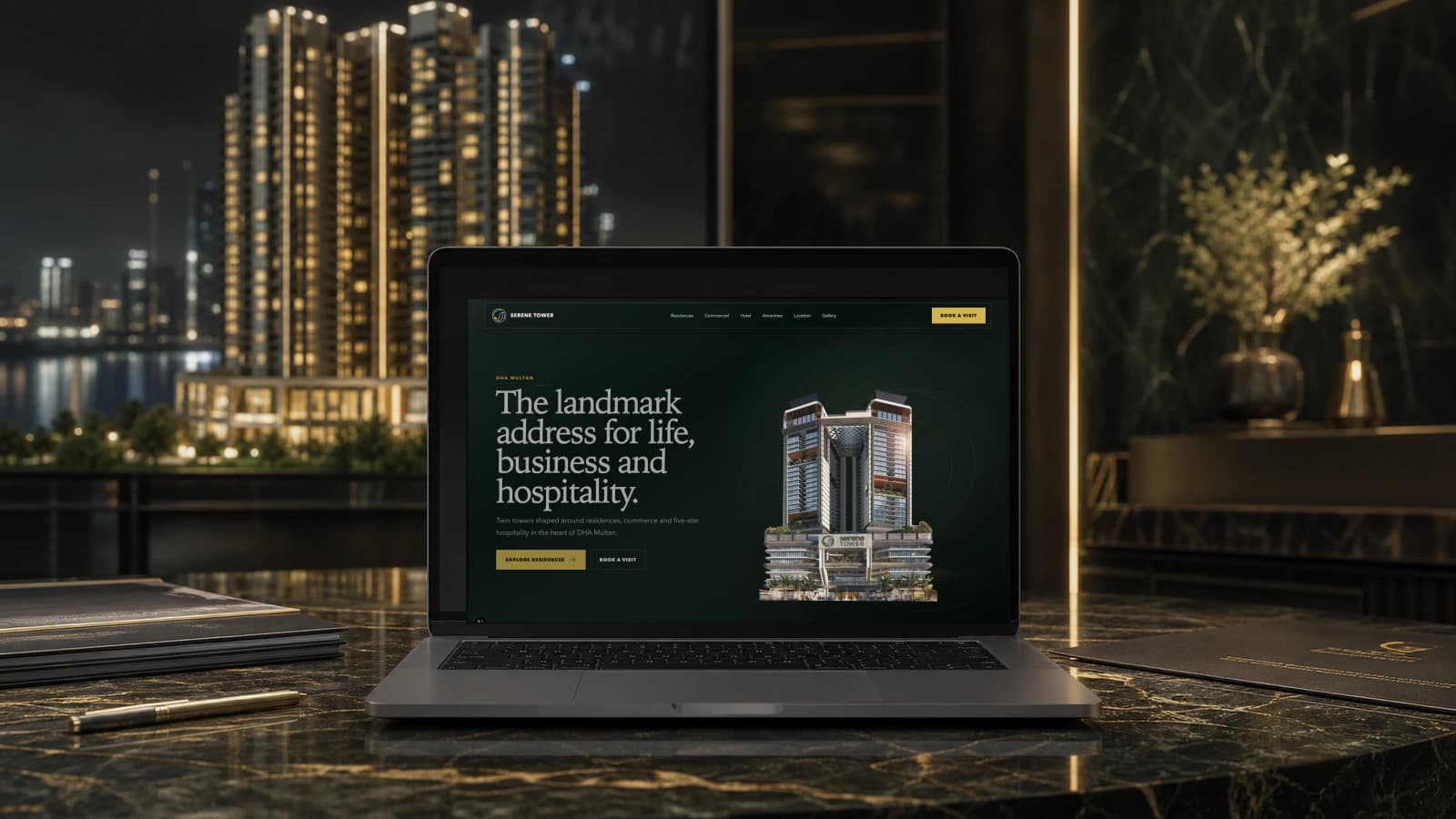
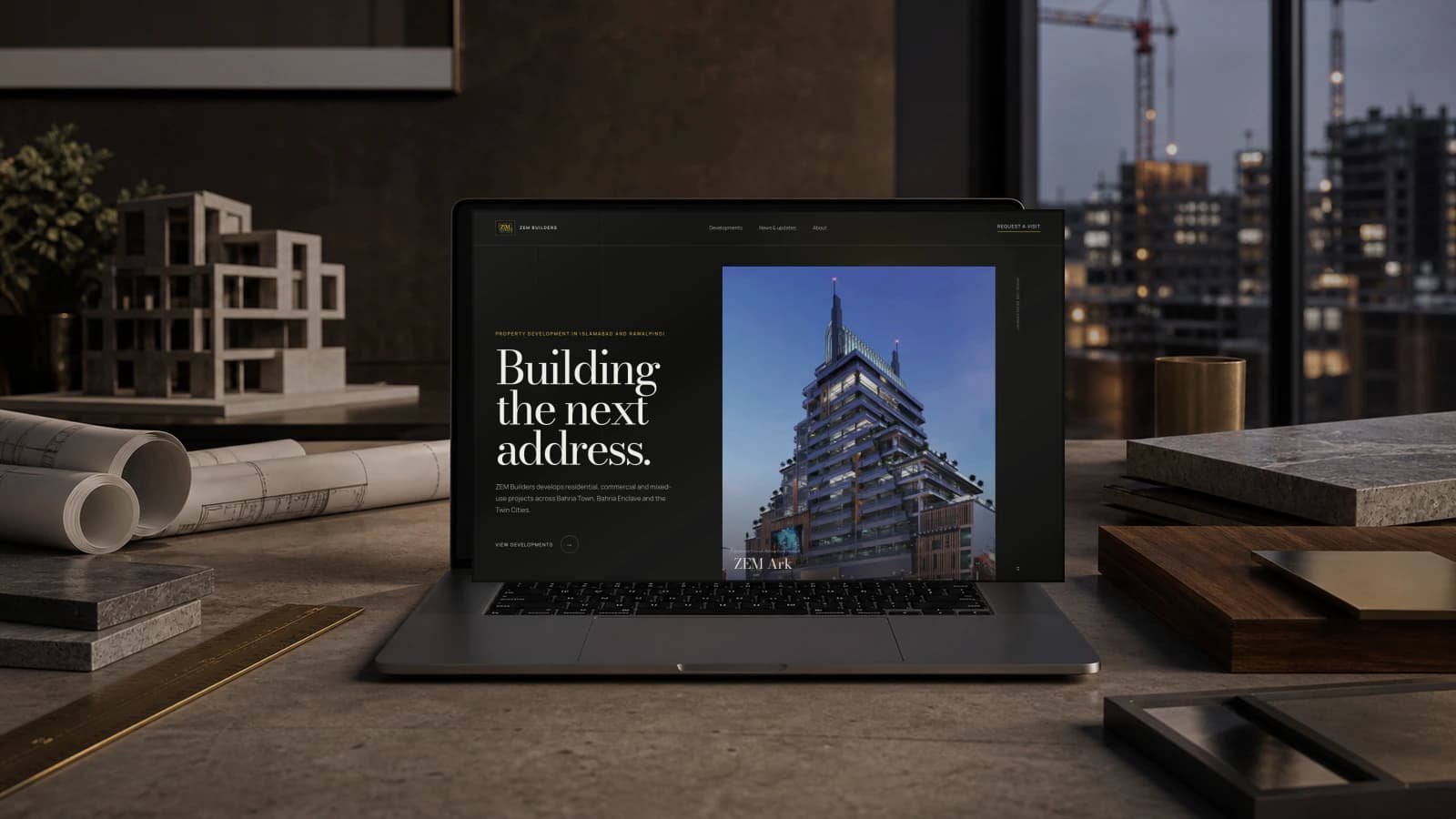
For a developer or brokerage, that means listing and project templates with a place for the permit number and QR code, unit pages that work in Arabic and English, and enquiry forms that route into a CRM rather than a shared inbox. Our real estate launch work so far has been for developers in Pakistan: Serene Tower in DHA Multan, the ZEM Builders project atlas, and 360 The Residences. The same patterns, from scroll-led project stories and unit journeys to construction evidence and direct enquiry paths, carry over to a UAE launch once Dubai's permit display and the Arabic version are added.
Personal data, accessibility and e-invoicing
Federal Decree-Law 45 of 2021, the Personal Data Protection Law, covers personal data of people in the UAE whether the controller or processor sits inside or outside the country, bars processing without consent except in listed cases, and sets conditions for transfers abroad. DIFC and ADGM run their own data protection regimes, and a 2026 Chambers guide notes that the federal law's implementing regulations have yet to be issued and that most organisations run compliance through internal risk assessments. Because we work from Islamabad, we set up forms, analytics and CRM connections in accounts your business owns, collect only the fields you need, and add consent controls and a privacy notice that your adviser matches to mainland, DIFC or ADGM rules.
The National Digital Accessibility Policy guides federal government entities to meet WCAG 2.1 at level AA, and the UAE government design system follows the same standard. The policy is written for government, but it gives private businesses a locally recognised benchmark, and we can scope and test a build against it in both languages.
E-invoicing is arriving for business-to-business and business-to-government trade. Under Ministerial Decisions 243 and 244 of 2025, as amended in 2026, businesses with revenue of AED 50 million or more must appoint an accredited service provider by 30 October 2026 and implement e-invoicing by 1 January 2027; smaller businesses follow on 1 July 2027 and government entities on 1 October 2027. Transactions with consumers are excluded until the Minister decides otherwise, and e-invoice data must be stored within the UAE. A consumer-only store is out of scope for now, but a B2B ordering portal needs clean order and customer data that your ERP and provider can turn into compliant invoices, and we plan that handoff during discovery.
Islamabad to the United Arab Emirates
2,080 km from our team, measured to Abu Dhabi.
Working across time zones.
The UAE is one hour behind Islamabad all year, so calls and review sessions are scheduled inside your normal business day.
The UAE uses Gulf Standard Time (UTC+4) and does not observe daylight saving; Islamabad uses Pakistan Standard Time (UTC+5), also without daylight saving. Islamabad is therefore always exactly one hour ahead: 09:00-18:00 in Dubai, Abu Dhabi or Sharjah is 10:00-19:00 in Islamabad, a 10:00 review in Dubai is 11:00 in Islamabad, and a 16:00 call is 17:00. Since January 2022 the federal government has worked Monday to Friday midday with a Saturday-Sunday weekend, and since January 2026 Friday prayers across the UAE have been held at 12:45 (13:45 in Islamabad). Private employers set their own rest days, so we confirm your team's week at kickoff and keep Friday sessions to the morning.
What a build in the UAE needs.
Arabic and right-to-left delivery
Arabic is the official language and one of the two most widely spoken. We deliver Arabic, English and multilingual sites with text direction set in the markup, logical CSS so layouts mirror cleanly, Arabic-ready typography and forms, and separate URLs with hreflang for each language.
Consumer protection for online stores
Cabinet Decision 66 of 2023 requires e-commerce sellers to show product particulars, return terms and a specification statement in Arabic as well as the original language, bars credit card surcharges, and requires prior permission before discounts are advertised. We model these as structured product fields so both language versions stay complete.
Personal data under the PDPL, DIFC and ADGM
The federal PDPL applies to personal data of people in the UAE wherever it is processed, while DIFC and ADGM have their own regimes. We build consent-aware forms and cookie controls, keep data in accounts you own, and leave the privacy notice wording to your adviser.
Dubai real estate advertising permits
The Dubai Land Department requires the Madmoun QR code linked to each Trakheesi permit on all real estate advertisements. We add fields for the permit number and QR code to listing and project templates so they appear wherever a listing does.
E-invoicing for B2B sales
E-invoicing becomes mandatory on 1 January 2027 for businesses with revenue of AED 50 million or more and on 1 July 2027 for smaller businesses; consumer sales are excluded for now. For B2B portals we plan clean order data for your ERP and accredited service provider. We do not act as the provider.
What Xsofty can build for UAE clients.
Web Design & Development
High-performance websites shaped around your brand, your audience, and the outcomes that matter.
- Strategy
- Next.js
- CMS
Arabic & Multilingual Websites
Right-to-left Arabic layouts and bilingual websites, planned for reading and for search in each language.
- Arabic RTL
- Bilingual
- hreflang
E-Commerce Development
Fast, frictionless storefronts that turn discovery into purchase across every screen.
- Shopify
- WooCommerce
- Conversion
Brand & UI/UX Design
Distinct identities and intuitive digital systems that make every interaction feel unmistakably yours.
- Identity
- Research
- Design systems
Custom Web Apps & AI Integrations
Purpose-built platforms and useful AI workflows that remove friction from complex operations.
- Web apps
- Automation
- AI
Mobile App Development
iOS and Android apps built alongside the web app and API behind them, so every screen works from the same data.
- iOS
- Android
- APIs
SEO & Digital Growth
Search foundations, content direction, and measurable improvements designed to compound over time.
- Technical SEO
- Content
- Analytics
Website Maintenance & Care Plans
Proactive updates, monitoring, and support that keep your digital presence secure and performing.
- Support
- Security
- Performance
Who we build for in the UAE.
Real estate developers and brokerages
Launch sites for buyers of many nationalities, Arabic and English project and unit pages, Trakheesi permit and QR display on listings, and enquiries routed into a CRM.
Fashion, beauty and retail brands
Mobile-first storefronts with Arabic product data, card, wallet and cash-on-delivery options, and clearly published return and replacement terms.
Logistics, trade and free zone companies
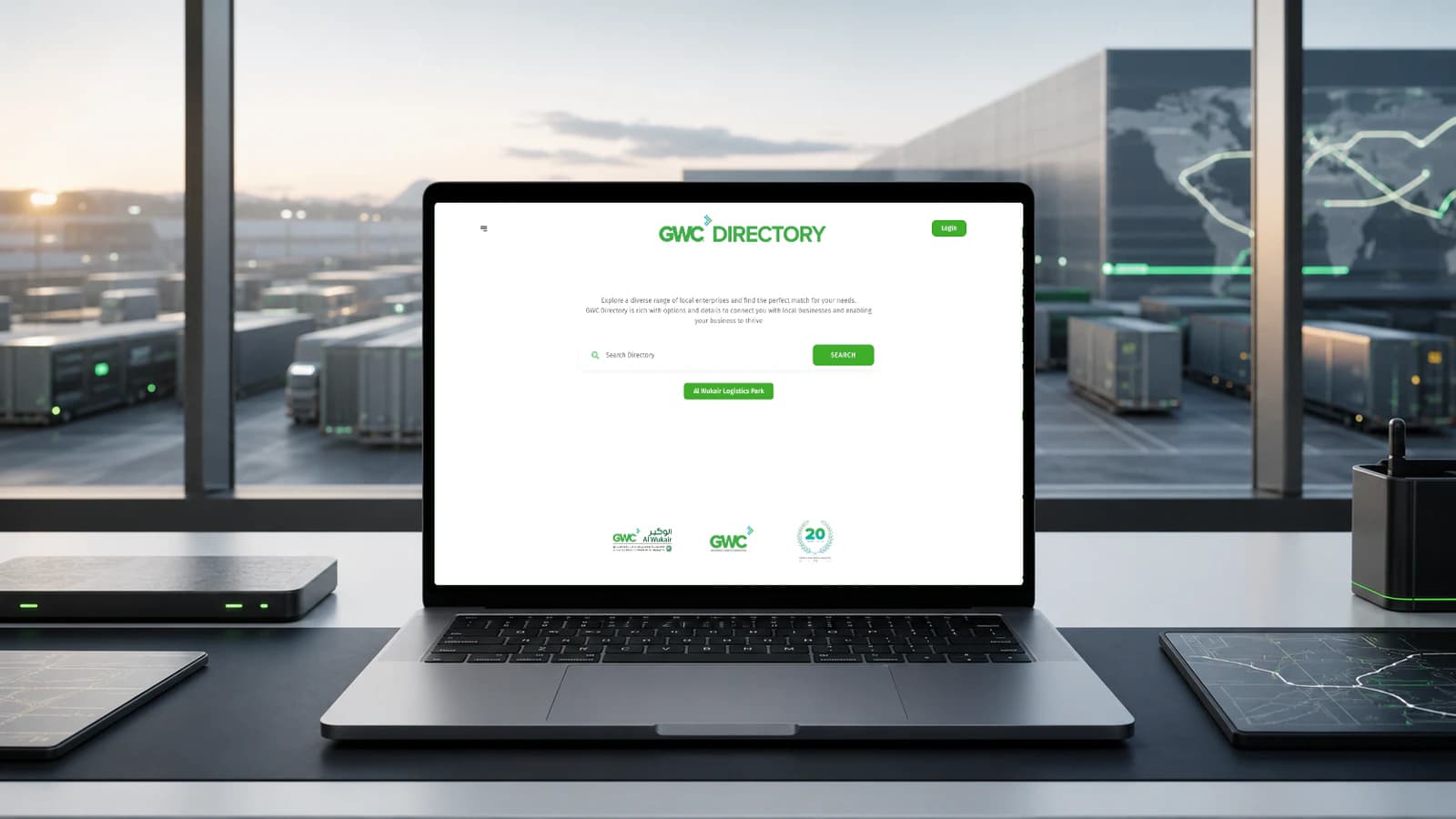
Searchable directories, service catalogues and quote flows for a trade hub built around ports such as Jebel Ali, plus B2B portals with order data ready for e-invoicing. GWC Directory, built for a Qatar client, is our closest reference.
Professional services and financial-centre firms
Credibility-led sites with bilingual service pages, short enquiry paths and privacy notices matched to mainland, DIFC or ADGM rules.
Architecture, interiors and contracting
Portfolio sites where project imagery leads, backed by a clear service structure and a direct route to a consultation.
Relevant work
Our UAE work includes the portfolio website of Roshaan Sheikh, a Dubai-based product and digital transformation leader. The other Gulf work shown here is for Qatar clients, The Closet and GWC Directory; our real estate launch sites were built for developers in Pakistan.


In our clients’ own words.
Hamza took the time to understand how I wanted my work and personal brand to come across online. He did not force a generic layout onto the project. The website feels considered, easy to navigate, and much closer to how I wanted to present myself professionally.
Questions from UAE clients.
No. Xsofty is based in Islamabad and works with UAE businesses remotely. Islamabad is one hour ahead of the UAE all year, so discovery calls, design reviews and launch checks are scheduled inside your working day.
Cities we work with in the UAE
Sources for this page (29)
- Arabic is the official language of the UAE (Constitution, Article 7) constituteproject.org (opens in a new tab)
- English and Arabic are the two most widely spoken languages in the UAE; visitors may also hear Urdu, Hindi or Pashtu uae-embassy.org (opens in a new tab)
- Luxury brands launched Arabic language sites to attract customers who avoided e-shopping due to language barriers trade.gov (opens in a new tab)
- W3C: set base direction with the dir attribute in markup, not CSS, and use logical start/end properties w3.org (opens in a new tab)
- Google recommends different URLs for each language version rather than cookies or browser settings developers.google.com (opens in a new tab)
- Google recommends telling it about localized versions of a page with hreflang annotations developers.google.com (opens in a new tab)
- Cabinet Decision 66/2023: Article 40 e-commerce particulars incl. Arabic specification statement, return and replacement terms and conformity mark on the website page; Article 5 debit card disclosure and no extra amount for credit card use; Article 31 prior permission from the competent authority for discounts and promotions moet.gov.ae (opens in a new tab)
- Credit cards are the most popular UAE e-commerce payment method, digital wallets are popular, and cash on delivery is still present though declining stripe.com (opens in a new tab)
- Cash on delivery preference in the UAE has fallen sharply as trust in digital payments grows checkout.com (opens in a new tab)
- CBUAE Finance Companies Regulation: short-term credit such as BNPL may be provided only by licensed finance companies or as agents of licensed banks or finance companies with CBUAE approval supportlegal.com (opens in a new tab)
- Aani is the central bank's instant payments platform, operated by Al Etihad Payments aep.ae (opens in a new tab)
- noon payments and NEOPAY launched an exclusive pilot bringing Aani instant payments to e-commerce merchants in November 2025 techafricanews.com (opens in a new tab)
- Dubai Land Department Q1 2026: real estate investment of AED 173 billion, with foreign investment at AED 148.35 billion (release does not define investor residency) dubailand.gov.ae (opens in a new tab)
- Madmoun issues a QR code for every Trakheesi real estate advertisement permit; real estate companies must display it on all real estate ads, visual or written dubailand.gov.ae (opens in a new tab)
- PDPL (Federal Decree-Law 45/2021) applies to controllers and processors inside or outside the UAE processing data of people in the UAE; processing without consent is prohibited except in listed cases; DIFC and ADGM regimes kept separate dlapiperdataprotection.com (opens in a new tab)
- PDPL covers personal data of UAE data subjects regardless of where the controller or processor is established and sets conditions for cross-border transfers trade.gov (opens in a new tab)
- PDPL implementing regulations have yet to be issued; most organisations drive compliance through internal risk assessments; DIFC and ADGM have standalone regimes practiceguides.chambers.com (opens in a new tab)
- National Digital Accessibility Policy: federal government entities are guided to achieve WCAG 2.1 level AA tdra.gov.ae (opens in a new tab)
- UAE government design system follows WCAG 2.1 and the AA level designsystem.gov.ae (opens in a new tab)
- Ministerial Decision 243/2025: e-invoicing applies to every business transaction of persons conducting business in the UAE, with listed exclusions; e-invoice data must be stored within the UAE (Article 11) mof.gov.ae (opens in a new tab)
- Ministerial Decision 244/2025: pilot from 1 July 2026; revenue under AED 50m implement by 1 July 2027; government entities by 1 October 2027; B2C transactions excluded until a Minister's decision mof.gov.ae (opens in a new tab)
- Ministerial Decision 66/2026: businesses with revenue of AED 50m or more appoint an accredited service provider by 30 October 2026 and implement by 1 January 2027 mof.gov.ae (opens in a new tab)
- From 1 January 2022 the federal government works Monday to Friday lunchtime with a Saturday-Sunday weekend; private employers choose their own rest day addleshawgoddard.com (opens in a new tab)
- From 2 January 2026 Friday prayers across the UAE are held at 12:45pm thenationalnews.com (opens in a new tab)
- UAE uses Gulf Standard Time (UTC+4) and does not observe daylight saving time en.wikipedia.org (opens in a new tab)
- Pakistan Standard Time is UTC+5 and daylight saving has not been observed since 2009 en.wikipedia.org (opens in a new tab)
- Jebel Ali Port is a premier trade gateway with over 80 weekly services connecting more than 150 ports dpworld.com (opens in a new tab)
- CBUAE's published exchange rates list the US dollar at AED 3.6725 (rates dated 1 June 2026) centralbank.ae (opens in a new tab)
- CBUAE maintains the dirham's peg to the US dollar by intervening in the foreign exchange market, buying US dollars at AED 3.672 and selling them at AED 3.673 centralbank.ae (opens in a new tab)