Websites for Qatar in Arabic and English, planned from day one

Qatar
Delivered remotely from Islamabad, Pakistan
Qatar's growth sectors and what they need online
Qatar's Third National Development Strategy (2024 to 2030) names manufacturing, logistics and tourism as its growth clusters, with financial services and education as enablers. Online, that means platforms that organise a supply chain, visitor and booking content, and credible sites for financial and education providers, alongside retail brands selling direct.
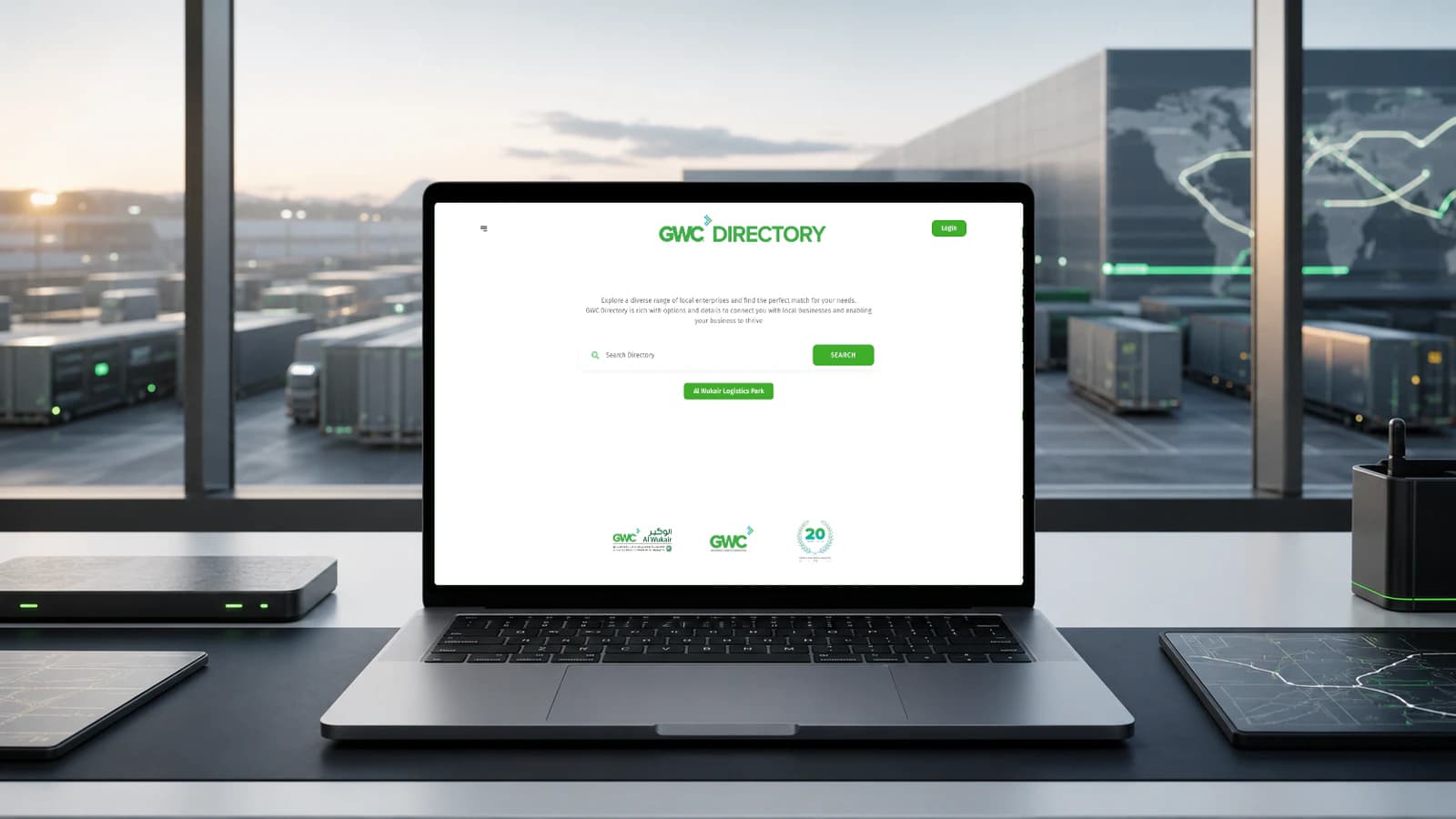
Our Qatar work covers two of those. GWC Directory is a directory platform for a logistics ecosystem, where the job was to make many organisations and categories searchable without the interface turning dense as content grows. The Closet is a fashion storefront built around mobile browsing and a cleaner path from product discovery to purchase.
Real estate briefs have their own shape here. Law No. 16 of 2018 lets non-Qataris own freehold property or hold 99-year rights in designated areas, with The Pearl, West Bay and Lusail among the freehold zones. A developer's site may therefore need to speak to Qatari buyers, resident expatriates and overseas investors in the same visit. We have built launch and project sites for developers in Pakistan, and the same structure carries over: construction progress, residences and unit journeys, location context, and a clear route to enquiry.
Arabic is designed in, not translated at the end
Arabic is the official language and English is commonly spoken in public places, so most Qatar sites need both. The real decision is which one leads. A consumer brand may open in Arabic; a B2B platform whose buyers are procurement teams may lead in English with full Arabic parity behind it.
Some of this is law rather than preference. Law No. 7 of 2019 on the Protection of the Arabic Language requires trademarks and trade names to be written in Arabic, with Arabic more prominent than any other language shown, and data on Qatari goods to be in Arabic. The commerce ministry has also required Arabic on invoices, service lists and product labels since 2017, with a second language allowed alongside.
We build the Arabic version as a true right-to-left layout rather than a flipped stylesheet: navigation, directional icons, forms, numbers and dates, and Arabic type that stays readable on small screens. Each language gets its own URLs with hreflang tags so search engines serve the right version, and order confirmations and invoices go out in Arabic as well as English.
Selling online: licensing, domains and payments
Ministerial Decision No. 25 of 2026, in force since 16 March 2026, requires businesses that trade online without a physical shop to hold an e-commerce licence from the Ministry of Commerce and Industry, with a separate licence for each platform. In September 2026 the ministry opened applications through the Single Window platform, covering 194 approved activities for a QAR 500 issuance fee. Local press coverage of the launch adds that the store's domain must end in .qa or .com.qa and be registered through one of eight providers regulated by the Communications Regulatory Authority. That rule is not in the published Decision, so confirm it with the ministry and settle the domain before the build starts; .com.qa is reserved for businesses registered in Qatar.
A licensed platform must display its commercial registration and e-commerce licence numbers, contact and customer-service details, exchange and return policies and complaint handling, and must offer electronic payment. Changes to licence details need ministry approval. The Consumer Protection Law (Law No. 8 of 2008) still applies too: prices must be shown clearly, buyers are entitled to a dated invoice, and false or deceptive product descriptions are prohibited.
The Qatar Central Bank licenses non-bank payment providers, and its licensed merchant acquirers include SkipCash, MyFatoorah, Dibsy, Sadad and Tap, with PayLater and Tamanna licensed for buy-now-pay-later. Himyan, Qatar's national payment card, runs over the local NAPS network and works on local shopping websites, so confirm your gateway accepts it before launch. A 2019 Ministry of Transport and Communications survey of online shoppers found cash on delivery was the most preferred payment method and that most expected local orders the same day or within one to two days. Check that against your own order data, but payment options and delivery times still belong next to the buy button.
E-invoicing is coming. The Council of Ministers approved a draft e-invoicing law on 6 May 2026; it still has to pass the Shura Council and be issued by the Amir, and rollout is anticipated from January 2027, starting with larger businesses. Qatar has not introduced VAT. Until the final rules are published, we keep order and invoice data structured so it can be exported cleanly.
Privacy, consent and hosting
Qatar's Personal Data Privacy Protection Law (Law No. 13 of 2016) is enforced by the National Cyber Security Agency. Article 22 bars electronic direct marketing without prior consent, and the agency's guidance is specific about what that means on a website: advertising cookies load only after the visitor clicks accept, a consent notice sits above the email field instead of a pre-ticked box, each marketing channel needs its own consent, and the business keeps evidence of every consent, ideally timestamped. Every marketing message must identify the sender and give an easy way to unsubscribe. Firms in the Qatar Financial Centre follow the separate QFC Data Protection Regulations 2021, so confirm which regime applies before the privacy notice is written.
The law does not generally require local hosting. Article 15 tells controllers not to restrict cross-border transfers unless the processing would breach the law or seriously harm the individual. Where a client or sector prefers data in-country, Microsoft has run an Azure cloud region in Qatar since August 2022.
Qatar's National e-Accessibility Policy dates from 2011 and promotes WCAG 2.1, with Mada, the country's assistive technology centre, supporting its implementation. The policy puts particular weight on public-sector adoption, so if you sell to government entities, name WCAG 2.1 in the brief and it is designed and tested for from the start rather than patched later.
Working across time zones.
Doha is two hours behind Islamabad all year, so a full Doha business day falls within Islamabad's working day and early evening, and calls sit inside your own hours.
Qatar keeps Arabia Standard Time (UTC+3) with no daylight saving, and Islamabad is UTC+5, also with no daylight saving, so the gap is a fixed two hours in summer and winter. A Doha day from 8:00 to 17:00 maps to 10:00 to 19:00 in Islamabad: a 9:00 kickoff in Doha is 11:00 in Islamabad, and a 15:00 design review in Doha is 17:00 in Islamabad. Qatar's weekend falls on Friday and Saturday, so review days are agreed at kickoff and approvals are not left waiting over a weekend. During Ramadan, private-sector hours in Qatar are capped at six a day and 36 a week, so review sessions are kept shorter and booked earlier in the Doha day.
What a build in Qatar needs.
Arabic and right-to-left layouts
Law No. 7 of 2019 requires trademarks and trade names in Arabic, with Arabic more prominent, and the commerce ministry requires Arabic on invoices and product labels. We deliver the Arabic site as a mirrored right-to-left build with its own URLs and hreflang, Arabic typography tuned for mobile, and Arabic order emails and invoice templates.
E-commerce licence, domain and disclosures
Under Ministerial Decision No. 25 of 2026, a licensed online store shows its commercial registration and e-commerce licence numbers, contact and customer-service details, and return and complaint procedures, and offers electronic payment. Press reports of the September 2026 launch add that the store must use a .qa or .com.qa domain from a CRA-regulated registrar; neither the published Decision nor the ministry's own announcement contains this rule, so treat it as unconfirmed until the ministry states it. We design these disclosures into the footer, checkout and policy pages in both languages, handle a domain move if one is needed, and flag any change that touches licence details so you can clear it with the ministry first.
PDPPL consent and direct marketing
National Cyber Security Agency guidance requires opt-in before advertising cookies load, consent notices instead of pre-ticked boxes, separate consent per marketing channel, and evidence of each consent. We set the cookie banner to hold marketing tags until the visitor accepts, add consent notices to forms, record consent with a timestamp, and make sure every email template carries sender details and an unsubscribe link.
Locally licensed payment gateways
Qatar Central Bank-licensed providers such as SkipCash, MyFatoorah, Dibsy, Sadad and Tap handle merchant acquiring, and the national Himyan card runs over the NAPS network. We integrate the gateway you contract with, check that Himyan cards are accepted, and can keep cash on delivery as a checkout option where your operations support it.
E-invoicing readiness
A draft e-invoicing law was approved by the Council of Ministers on 6 May 2026 and is still going through the legislative process, with rollout anticipated from January 2027 starting with larger businesses. We keep order and invoice data structured and exportable, so connecting to the tax authority's platform later is an integration task rather than a rebuild.
What Xsofty can build for Qatar clients.
Web Design & Development
High-performance websites shaped around your brand, your audience, and the outcomes that matter.
- Strategy
- Next.js
- CMS
Arabic & Multilingual Websites
Right-to-left Arabic layouts and bilingual websites, planned for reading and for search in each language.
- Arabic RTL
- Bilingual
- hreflang
E-Commerce Development
Fast, frictionless storefronts that turn discovery into purchase across every screen.
- Shopify
- WooCommerce
- Conversion
Custom Web Apps & AI Integrations
Purpose-built platforms and useful AI workflows that remove friction from complex operations.
- Web apps
- Automation
- AI
Mobile App Development
iOS and Android apps built alongside the web app and API behind them, so every screen works from the same data.
- iOS
- Android
- APIs
Brand & UI/UX Design
Distinct identities and intuitive digital systems that make every interaction feel unmistakably yours.
- Identity
- Research
- Design systems
SEO & Digital Growth
Search foundations, content direction, and measurable improvements designed to compound over time.
- Technical SEO
- Content
- Analytics
Website Maintenance & Care Plans
Proactive updates, monitoring, and support that keep your digital presence secure and performing.
- Support
- Security
- Performance
Who we build for in Qatar.
Logistics and supply chain
Searchable directories, partner and supplier portals, and data-heavy platforms that stay easy to scan as listings grow. GWC Directory is our Qatar example.
Fashion and retail e-commerce
Mobile-first catalogues in Arabic and English, e-commerce licence disclosures (and a .qa or .com.qa domain if the reported domain rule is confirmed), locally licensed payment gateways, and clear delivery and returns information. For mobile-first catalogue browsing, The Closet, a fashion storefront for a Qatar client, is our reference.
Real estate and development
Project sites that serve Qatari buyers, resident expatriates and overseas investors in designated ownership areas, with unit journeys, construction progress, location context and bilingual enquiry forms.
Tourism and hospitality
Visitor-facing sites with booking or enquiry flows, strong imagery and parallel Arabic and English content, for a sector the national strategy names as a growth cluster.
Financial services and fintech
Trust-led corporate sites and client portals, with privacy notices written for the right regime, whether the PDPPL or the QFC Data Protection Regulations.
Education and training
Bilingual sites for parents, students and partners, with admissions or enquiry flows and content that is easy to keep current in both languages.
Relevant work
Our Qatar work includes The Closet, a fashion e-commerce storefront, GWC Directory, a directory platform for a logistics ecosystem, BEAT, the website for a fitness brand, and Badria Kafood Architecture, a bilingual English and Arabic website for a Doha practice.



In our clients’ own words.
1 of 4
We wanted a website that felt clean and confident without losing the character of the brand. Xsofty found that balance. The products are easier to browse, the mobile experience feels considered, and the overall presentation finally matches the standard we want customers to associate with The Closet.
Questions from Qatar clients.
No. Xsofty is based in Islamabad and works remotely with businesses in Qatar. Discovery calls and design reviews are scheduled in Doha working hours, which is easy because Islamabad is only two hours ahead.
Cities we work with in Qatar
Further reading
- Qatar e-commerce licence: what websites must show
What a Qatar online store must show under Decision 25 of 2026, the PDPPL, and consumer and Arabic-language laws, where each rule sits and how to test it.
- Qatar payment gateways for WooCommerce and Shopify
Shopify Payments and Stripe don't cover Qatar. Compare SkipCash, MyFatoorah, Sadad, Dibsy, Tap and bank gateways for WooCommerce and Shopify stores.
Sources for this page (26)
- NDS3 (2024-2030) growth clusters are manufacturing, logistics and tourism; enabling clusters are education and financial services invest.qa (opens in a new tab)
- Law No. 16 of 2018 allows non-Qatari ownership; freehold areas include West Bay (Katifiya), The Pearl and Lusail (spelled 'Luasil'); other areas announced for 99 years propertyfinder.qa (opens in a new tab)
- Arabic is the official language and English is commonly spoken at all public places; embassies work Sunday to Thursday and close Friday and Saturday; business shuts during Friday prayers visitqatar.com (opens in a new tab)
- October 2025: Civil Service Bureau president denied rumours that Friday would become a working day, with no change to the current working week thepeninsulaqatar.com (opens in a new tab)
- Law No. 7 of 2019: trademarks and trade names in Arabic with Arabic more prominent (Art. 10); data on Qatari goods in Arabic (Art. 9); fines up to QAR 50,000 (Art. 11) almeezan.qa (opens in a new tab)
- Commerce ministry required Arabic on invoices, service lists and product labels by 31 March 2017, with another language permitted alongside thepeninsulaqatar.com (opens in a new tab)
- Consumer Protection Law No. 8 of 2008: clear price display and right to a dated invoice (Art. 8); false or deceptive descriptions prohibited (Art. 7) almeezan.qa (opens in a new tab)
- Decision of the Minister of Commerce and Industry No. (25) of 2026, Arabic text (Official Gazette No. 5, 15 March 2026; in force the day after publication): licence required before trading online (Art. 2); a separate licence for each website (Art. 4); electronic payment, CR and licence numbers, contact and customer-service details, exchange and return policy, consumer-protection measures and complaint procedures on the site (Art. 5). The text contains no domain requirement. almeezan.qa (opens in a new tab)
- Ministerial Decision No. 25 of 2026 (in force 16 March 2026): e-commerce licence for activity without physical premises; separate licence per platform; display of CR and licence numbers, contact and customer-service details, return and complaint policies; electronic payment; MoCI approval for changes to licence details crowell.com (opens in a new tab)
- Decision No. 25 of 2026 requires electronic payment methods and ministry approval of changes to the licensed website or business details alansarilaw.com (opens in a new tab)
- Press report (17 September 2026): MoCI launched the e-commerce licence for 194 approved activities, QR500 fee, applications via the Single Window platform; domain must end in .qa or .com.qa, registered through one of eight CRA-regulated providers thepeninsulaqatar.com (opens in a new tab)
- Press report: E-commerce licence under Decision No. 25 of 2026 covers 194 activities; domain must end in .qa or .com.qa via one of eight CRA-regulated service providers qatarliving.com (opens in a new tab)
- MoCI announcement (17 September 2026): the E-Commerce Licence launched under Decision No. (25) of 2026 covers 194 approved business activities with a QAR 500 issuance fee, and applications can be submitted electronically; the English announcement does not mention a domain requirement moci.gov.qa (opens in a new tab)
- QCB-licensed merchant acquirers include SkipCash, MyFatoorah, Dibsy, Sadad and Tap; PayLater and Tamanna are licensed BNPL platforms gulf-times.com (opens in a new tab)
- Himyan is Qatar's first national prepaid payment card, processed via NAPS, usable at points of sale, ATMs and local shopping websites gulf-times.com (opens in a new tab)
- March 2019 impact survey on online shoppers' preferences (published on ecommerce.gov.qa by MoTC): almost half prefer cash on delivery; about 75% expect local delivery same day or within 1-2 days ecommerce.gov.qa (opens in a new tab)
- Council of Ministers approved a draft e-invoicing law on 6 May 2026; it proceeds to the Shura Council and the Amir; implementation anticipated from 1 January 2027, phased from larger businesses ey.com (opens in a new tab)
- Qatar has not yet officially implemented VAT (May 2026) edicomgroup.com (opens in a new tab)
- NCSA guideline on PDPPL Article 22: prior consent for electronic direct marketing; advertising cookies only after opt-in; consent notice above the email field, no pre-ticked boxes; consent per channel; evidence of consent ideally timestamped; sender identity and unsubscribe in every message ncsa.gov.qa (opens in a new tab)
- NCSA enforces the PDPPL; QFC entities fall under the separate QFC Data Protection Regulations 2021; PDPPL Article 15 bars controllers from restricting cross-border transfers unless processing violates the law or may cause serious damage; no general localisation requirement practiceguides.chambers.com (opens in a new tab)
- Microsoft opened its Azure and Microsoft 365 datacenter region in Qatar on 31 August 2022 news.microsoft.com (opens in a new tab)
- .qa is open to all; .com.qa is for companies and businesses registered in Qatar cra.gov.qa (opens in a new tab)
- Qatar's National e-Accessibility Policy launched in 2011 by MCIT promotes WCAG 2.1; Mada supports its implementation; the article stresses public-sector adoption nafath.mada.org.qa (opens in a new tab)
- Ramadan 2026 private-sector working hours capped at 36 per week and six per day under the Labour Law thepeninsulaqatar.com (opens in a new tab)
- Stripe's list of supported countries does not include Qatar (checked 28 September 2026) stripe.com (opens in a new tab)
- Shopify Payments is not available in Qatar; stores in countries missing from the supported list must use a third-party payment provider (checked 28 September 2026) help.shopify.com (opens in a new tab)