Websites for Pakistani businesses, built in Islamabad

Pakistan
Delivered remotely from Islamabad, Pakistan
What a Pakistani brief usually has to solve
Many Pakistani small businesses sell before they have a website. Textile and clothing sellers, handicraft makers, home kitchens and appliance dealers show products on Facebook, Instagram, TikTok and WhatsApp, and customers order by message or phone. A website does not need to replace that. Its job is to be the page people check before they commit: who the company is, where it operates, what things cost, and how to reach a real person.
Language needs a decision at the start. Article 251 of the Constitution makes Urdu the national language and allows English to be used for official purposes. Many projects need both, and the balance depends on who is reading: an exporter's buyers read English, while a consumer brand may want Urdu product pages. Urdu is written right to left, usually in Nastaliq, a script whose sloping, stacked letterforms are harder to render digitally than Latin text and need noticeably more line height. We build separate language versions with right-to-left layouts and properly set Urdu type, instead of dropping translated strings into an English template. The same approach carries over to Arabic when a project also speaks to Gulf audiences.
Build for the connection visitors actually have. In 2025, Ookla's Speedtest Global Index placed Pakistan well below world averages for both mobile and fixed download speeds. Image weight, font loading and third-party scripts are business decisions here, not technical footnotes. A project gallery that crawls on a phone can lose the visitor before the enquiry form appears.
Real estate: selling to buyers here and abroad
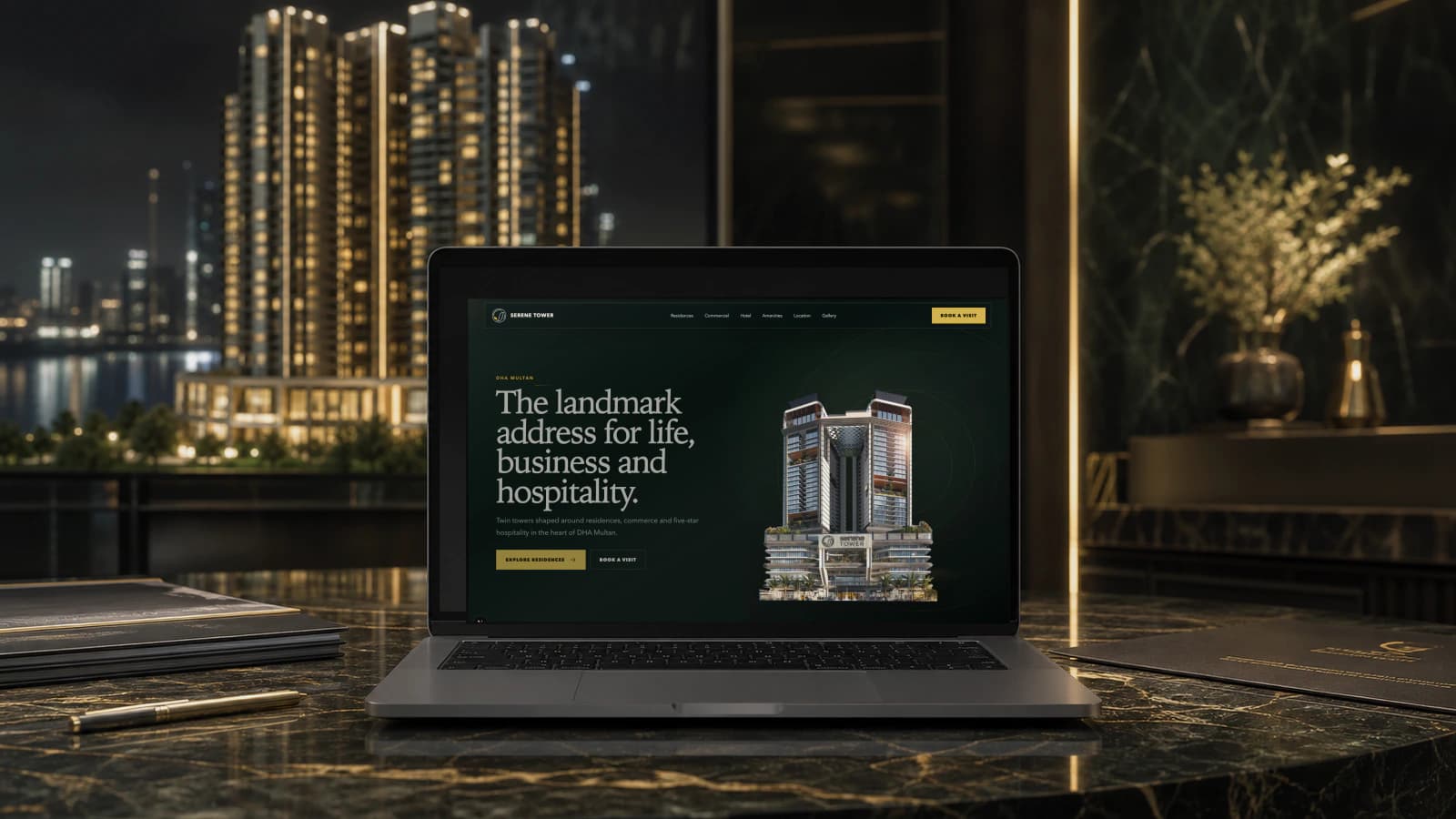
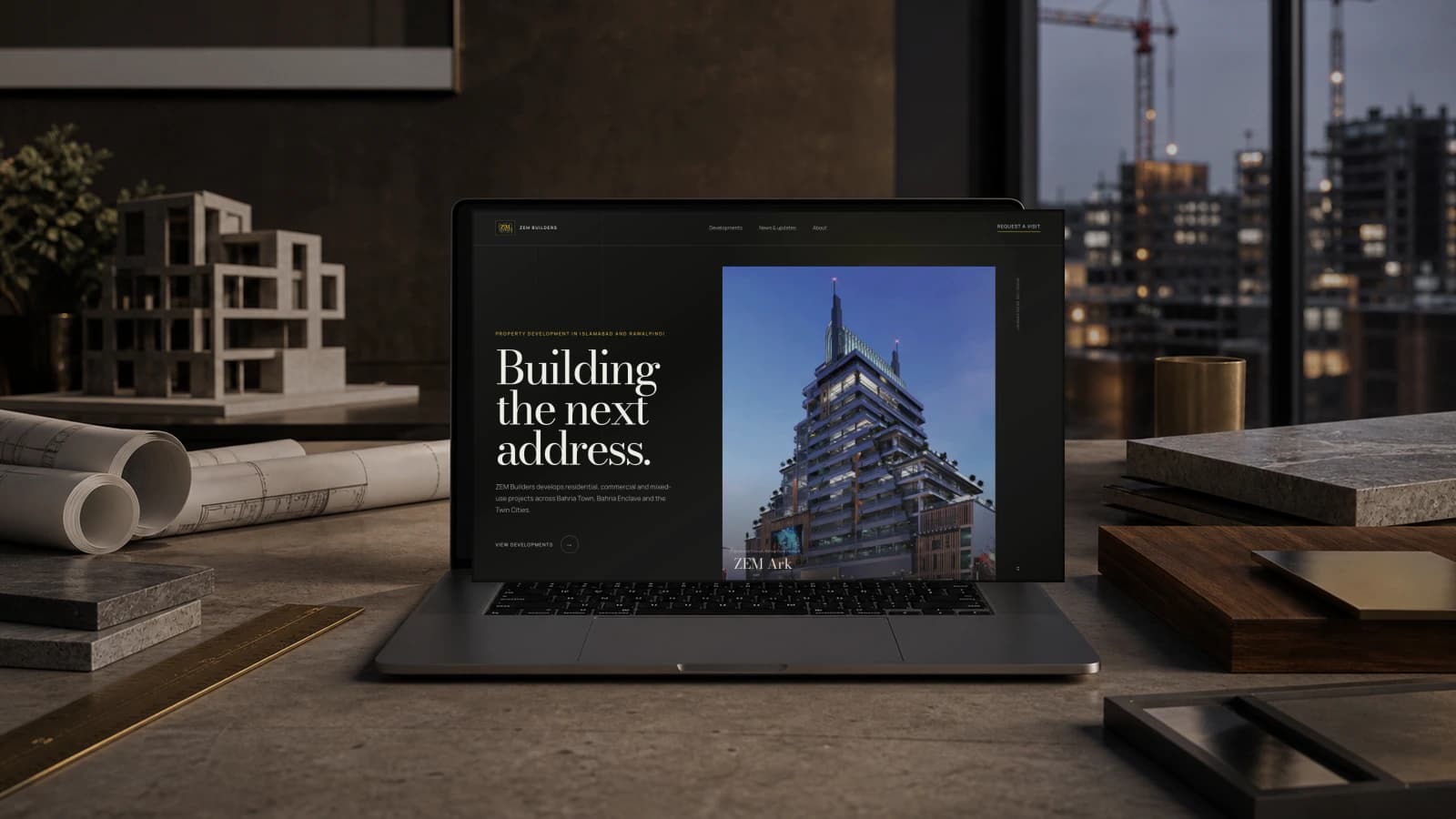
The Pakistani client projects in our portfolio are all in real estate. For 360 The Residences we built a scroll-led launch site around a construction story and verified development information. For Serene Tower, a mixed-use project in DHA Multan, we consolidated a heavy, fragmented property site into one route from positioning to residences and enquiry, keeping the development's real architectural media and unit journeys. For ZEM Builders we rebuilt a legacy corporate site that had become unavailable, recovering the developer's projects and construction evidence into a structured project atlas.
Property buyers are not all in Pakistan. State Bank data shows Saudi Arabia, the UAE and the UK were the three largest sources of workers' remittances in 2025-26, and Roshan Digital Account funds can be used to buy property in Pakistan. An overseas buyer usually cannot walk the site, so the website has to carry what a visit would: dated construction progress, location context, unit plans, payment plans, and an enquiry route that reaches the sales team across time zones.
Regulation matters here too. The Islamabad Real Estate (Regulation and Development) Act 2020 provides for a real estate regulatory authority in the capital, and its definition of advertisement covers material a developer issues through any medium. In Punjab, private housing scheme transactions are being moved onto the Punjab Land Record Authority's Housing Societies Management System, alongside a proposed real estate regulatory act. We are not your legal adviser, but we treat a project website as advertising: approvals, registration details and disclaimers get a planned place in the layout, with wording confirmed by your legal team.
Online stores: cash, wallets and tax records
Checkout in Pakistan still starts with cash on delivery. The government's 2019 e-commerce policy framework aimed to convert COD payments to digital, preferably by 2029, and withholding tax rules issued in 2025 make couriers responsible for collecting tax on COD orders. At the same time, State Bank data shows digital channels carried the large majority of retail transactions in 2024-25, and online payments lean towards bank accounts and wallets rather than cards. Raast, the State Bank's instant payment system, supports person-to-merchant payments, and JazzCash offers QR payments and an e-commerce payment gateway.
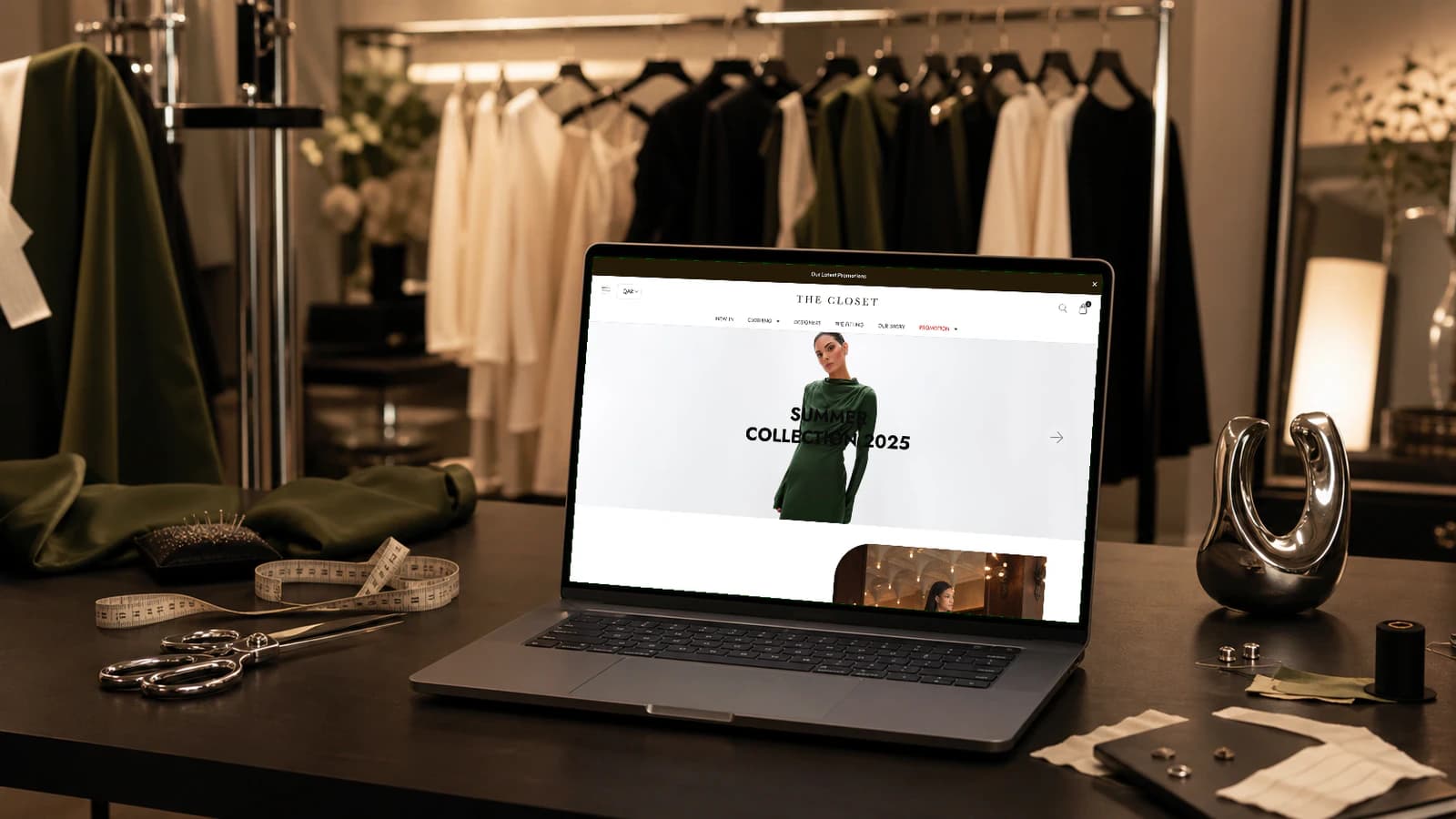
Stripe does not list Pakistan as a supported country, so a storefront theme built around it will not take payments as shipped. We design checkout around what your bank or wallet provider actually enables on your merchant account: COD with clear order confirmation, wallet and Raast payments, and cards through a local acquirer. Our e-commerce build for The Closet, a fashion client in Qatar, was shaped around product discovery and a cleaner path from browsing to purchase across devices. The same discipline applies here, with a different payment mix.
Records matter after launch. FBR requires sales-tax-registered businesses to issue invoices electronically through a licensed integrator, with the last group of registrants due to go live by 31 December 2025, and payment intermediaries and couriers now withhold tax on digitally ordered goods. We structure order data so it can pass to your ERP or integrator and be reconciled with gateway and courier statements. Consumer law is set separately by Islamabad and each province. Punjab's 2005 Act requires displayed prices, a receipt showing the seller's name and address, and a refund policy disclosed before the sale. It is written for shop premises, so we carry the same disclosures online: prices on product pages, a complete order confirmation, and returns terms visible before checkout.
Privacy, accessibility and working together
Pakistan has no enacted comprehensive data protection law. The Personal Data Protection Bill had completed consultation but, as of March 2026, had not passed both houses of Parliament. The Prevention of Electronic Crimes Act 2016 sets penal sanctions for misuse of personal information, but it is not a full privacy framework. The draft bill would require explicit consent for sensitive data, breach notices within 72 hours where feasible, and processing of critical personal data on servers in Pakistan. We build forms that collect only what an enquiry needs, publish a plain privacy notice, and choose hosting that can be moved if the bill passes in that form.
Accessibility follows a similar pattern. Pakistani law, including the ICT Rights of Persons with Disability Act 2020, calls for accessibility, but no statute names WCAG or any other technical standard, so web compliance is effectively voluntary. We still work to WCAG's core checks for contrast, keyboard use and labelled forms, because the same fixes make a site easier to use on a phone.
Pakistan runs on one time zone, so there is no time difference to plan around. Xsofty is based in Islamabad, and we run projects through video calls, shared design reviews and written decisions, so a client in Lahore, Karachi or Multan works with us the same way as one in the capital. Packages start at USD 1,490, with larger builds priced by proposal.
Working across time zones.
Pakistan keeps one time zone all year, the same as ours, so every call sits inside your normal working day.
Pakistan Standard Time (Asia/Karachi) is UTC+5 all year, with no daylight saving since 2009. The offset from Islamabad is zero: 10:00 in Karachi, Lahore, Multan or Peshawar is 10:00 in Islamabad in every month. When a project also serves overseas buyers or partners, we schedule review sessions in Gulf and US working hours. Saudi Arabia (UTC+3) is two hours behind Pakistan and the UAE (UTC+4) is one hour behind, all year, so a 10:00 Riyadh session is 12:00 in Islamabad and a 10:00 Dubai session is 11:00. US Eastern time is nine hours behind Pakistan during US daylight saving (second Sunday in March to first Sunday in November; 8 March to 1 November in 2026) and ten hours behind the rest of the year, so a 09:00 New York call is 18:00 in Islamabad in the US summer and 19:00 in the US winter.
What a build in Pakistan needs.
English and Urdu, including right-to-left
Article 251 makes Urdu the national language and allows English for official purposes. Urdu is written right to left, usually in Nastaliq, whose cascading letterforms need much more line height than Latin text. We build separate language versions with RTL layouts, Nastaliq web fonts with adjusted line height, and correct language tags, so Urdu pages are designed rather than poured into an English layout. The same RTL approach covers Arabic for Gulf-facing projects.
Checkout without Stripe
Stripe does not list Pakistan as a supported country, and cash on delivery is still the starting point for online orders. We plan checkout around COD plus the options your bank or wallet provider enables on your merchant account, such as Raast person-to-merchant payments, a wallet gateway such as JazzCash, and cards through a local acquirer. The provider is confirmed before checkout design starts.
FBR digital invoicing and e-commerce tax
FBR requires sales-tax-registered businesses to issue invoices electronically through a licensed integrator, and PRAL offers that integration free of charge. Since 2025, couriers and payment intermediaries also withhold tax on digitally ordered goods. We do not replace the integrator. We structure order, customer and payment data so it can pass to your ERP or integrator and be reconciled with courier and gateway statements.
Consumer disclosures before the sale
Islamabad and each province have their own consumer protection statute. Punjab's 2005 Act, for example, requires prices to be displayed, a receipt showing the date, goods, quantity, price and the seller's name and address, and a return and refund policy disclosed before the transaction is completed. The Act is written for shops, so we carry the same disclosures online: visible product prices, a complete order confirmation, and returns terms shown before checkout.
Privacy while the data protection bill is pending
Pakistan has no enacted comprehensive data protection law. PECA 2016 sets penal sanctions for misuse of personal information, and the Personal Data Protection Bill had not passed Parliament as of March 2026. We build to the draft's main principles: consent-based forms that collect only what is needed, a plain privacy notice, and hosting choices that can move if critical personal data must stay on servers in Pakistan.
What Xsofty can build for Pakistan clients.
Web Design & Development
High-performance websites shaped around your brand, your audience, and the outcomes that matter.
- Strategy
- Next.js
- CMS
E-Commerce Development
Fast, frictionless storefronts that turn discovery into purchase across every screen.
- Shopify
- WooCommerce
- Conversion
Brand & UI/UX Design
Distinct identities and intuitive digital systems that make every interaction feel unmistakably yours.
- Identity
- Research
- Design systems
Custom Web Apps & AI Integrations
Purpose-built platforms and useful AI workflows that remove friction from complex operations.
- Web apps
- Automation
- AI
SaaS & Product Development
Multi-tenant web products with subscriptions, roles, billing, and the dashboards customers use every day.
- Multi-tenant
- Subscriptions
- Dashboards
Mobile App Development
iOS and Android apps built alongside the web app and API behind them, so every screen works from the same data.
- iOS
- Android
- APIs
SEO & Digital Growth
Search foundations, content direction, and measurable improvements designed to compound over time.
- Technical SEO
- Content
- Analytics
Google Workspace & Business Email
Business email on your own domain, with the accounts, DNS records, and move from your old provider handled.
- Business email
- DNS
- Migration
Who we build for in Pakistan.
Real estate developers and housing projects
Project sites that show dated construction progress, location, unit plans, payment plans and approvals clearly, with enquiry routes that reach the sales team from buyers in Pakistan and overseas.
Textile and apparel exporters
Textiles are Pakistan's largest export group. Exporters need English-first sites that present capacity, product ranges and compliance documents to overseas buyers, with enquiries routed straight to the export desk.
Fashion and consumer brands
Mobile storefronts that receive traffic from Instagram, TikTok and WhatsApp, support cash on delivery and wallet payments, and show prices and returns terms before checkout.
IT and software services firms
IT and IT-enabled services exports reached a record in 2025-26, and these firms sell abroad. They need sites that hold up to international comparison: clear service pages, structured case studies and careers pages.
Construction and architecture practices
Portfolio-led sites where project imagery carries the argument, organised so prospective clients can find relevant work by type, scale and location.
Relevant work
The Pakistani client work shown here is real estate (360 The Residences, ZEM Builders and Serene Tower in DHA Multan), and our e-commerce reference, The Closet, was built for a fashion client in Qatar.

In our clients’ own words.
1 of 3
Working with Hamza was straightforward from the beginning. He listened carefully, explained the thinking behind the design, and kept the website focused on what buyers actually need to see. The final result gives 360 The Residences a much stronger and more professional digital presence.
Questions from Pakistan clients.
Yes. Xsofty is based in Islamabad, and projects run through video calls, shared design reviews and written decisions, so the process is the same whether you are in Rawalpindi, Lahore, Karachi or Multan. Our real estate work includes Serene Tower in DHA Multan.
Cities we work with in Pakistan
Sources for this page (32)
- Urdu is the national language of Pakistan under Article 251; English may be used for official purposes; provinces may promote provincial languages infopakistan.pk (opens in a new tab)
- Nastaliq is the common script for Standard Urdu, written right to left, and is complex to render digitally (Noori Nastaliq used over 20,000 ligatures) en.wikipedia.org (opens in a new tab)
- Urdu Nastaliq runs right to left with a sloping, cascading baseline that can need much larger line height than many other orthographies r12a.github.io (opens in a new tab)
- Pakistani small businesses (textiles and fashion, handicrafts, home kitchens, appliances) use Facebook, Instagram, TikTok and WhatsApp as storefronts; customers order by message or phone call (12 September 2026) tribune.com.pk (opens in a new tab)
- Ookla Speedtest Global Index places Pakistan well below world averages for mobile and fixed download speeds (4 September 2025) digitalrightsmonitor.pk (opens in a new tab)
- Saudi Arabia, the UAE and the UK were the three largest sources of workers' remittances to Pakistan in FY2025-26 (SBP data, 9 July 2026) geo.tv (opens in a new tab)
- Roshan Digital Account funds can be used to purchase real estate in Pakistan; RDA launched by SBP with commercial banks abl.com (opens in a new tab)
- Islamabad Real Estate (Regulation and Development) Act 2020 provides for the Real Estate Regulatory Authority for the capital na.gov.pk (opens in a new tab)
- The Islamabad Real Estate (Regulation and Development) Act 2020 is listed as enacted law in Pakistan Code pakistancode.gov.pk (opens in a new tab)
- The Islamabad Act defines advertisement as any document issued by a developer or authorised agent as advertisement through any medium faolex.fao.org (opens in a new tab)
- Punjab is moving private housing scheme transactions onto the Punjab Land Record Authority's Housing Societies Management System under a proposed Real Estate Regulatory Act (16 April 2026) propakistani.pk (opens in a new tab)
- The 2019 e-commerce policy framework aimed to convert all cash-on-delivery payments to digital, preferably within 10 years (2029) dawn.com (opens in a new tab)
- Under SRO 1429(I)/2025 (Finance Act 2025), payment intermediaries withhold tax on digital payments and couriers on cash-on-delivery payments for digitally ordered goods vatupdate.com (opens in a new tab)
- 2025-26 budget: couriers collect tax on cash-on-delivery orders and payment gateways deduct it on online payments arabnews.pk (opens in a new tab)
- SBP: digital channels accounted for 88 percent of retail transactions in FY2024-25, and account- and wallet-based channels made up 93 percent of online transactions arabnews.pk (opens in a new tab)
- Raast is Pakistan's instant payment system operated by SBP, supporting person-to-merchant payments en.wikipedia.org (opens in a new tab)
- JazzCash offers QR-based payments and an e-commerce payment gateway en.wikipedia.org (opens in a new tab)
- Stripe does not list Pakistan among supported countries stripe.com (opens in a new tab)
- FBR electronic invoicing is mandatory for corporate and non-corporate registered persons through licensed integrators; PRAL provides free integration fbr.gov.pk (opens in a new tab)
- SRO 1852 of 2025 set phased e-invoicing deadlines for sales tax registrants, with the last category to start issuing e-invoices by 31 December 2025 (26 September 2025) dawn.com (opens in a new tab)
- Punjab Consumer Protection Act 2005: s.18 price display in the shop, s.19 receipt with date, goods, quantity, price and seller name and address, s.20 refund policy disclosed before the transaction at the point of purchase nasirlawsite.com (opens in a new tab)
- Punjab consumer protection guidelines confirm price display, receipt and refund-policy obligations and fines pcpc.punjab.gov.pk (opens in a new tab)
- Pakistan has separate consumer protection statutes for Islamabad and each of the four provinces pljlawsite.com (opens in a new tab)
- Pakistan has no enacted comprehensive data protection law; PECA 2016 sets penal sanctions for misuse of personal information; the draft bill is pending dlapiperdataprotection.com (opens in a new tab)
- As of 10 March 2026 the draft data protection bill had completed consultation but not passed both houses; the draft requires explicit consent for sensitive data, breach notification within 72 hours where feasible, and processing of critical personal data on servers in Pakistan practiceguides.chambers.com (opens in a new tab)
- Pakistan's laws mandate accessibility, but no statute references WCAG or another technical standard, so compliance is voluntary (22 April 2026) nation.com.pk (opens in a new tab)
- Pakistan Standard Time is UTC+5 and daylight saving has not been observed since 2009 en.wikipedia.org (opens in a new tab)
- Saudi Arabia is UTC+3 with no daylight saving en.wikipedia.org (opens in a new tab)
- The UAE is UTC+4 (Gulf Standard Time) with no daylight saving en.wikipedia.org (opens in a new tab)
- US Eastern Time is UTC-5 standard and UTC-4 daylight; DST runs from the second Sunday in March to the first Sunday in November (8 March to 1 November 2026) en.wikipedia.org (opens in a new tab)
- Textiles are Pakistan's largest export group, 60.46 percent of exports (PBS data, 20 October 2025) profit.pakistantoday.com.pk (opens in a new tab)
- Pakistan's IT and IT-enabled services exports reached a record $4.6 billion in FY2025-26 (SBP data) propakistani.pk (opens in a new tab)