A web design agency built in Islamabad

Islamabad
Delivered remotely from Islamabad, Pakistan
Who commissions websites in the twin cities
Islamabad and Rawalpindi work as one market with two characters. Islamabad is the seat of federal government, home to more than twenty universities and a Diplomatic Enclave that houses dozens of embassies and high commissions. Rawalpindi carries the industrial, commercial and military side of the pair, serves as a logistics centre for northern Pakistan, and its suburban housing developments are home to many people who work in Islamabad.
Technology is the other anchor. Islamabad's software technology parks already house local and foreign IT companies, and the Islamabad Technology Park at Chak Shahzad, a Ministry of IT and Pakistan Software Export Board project, is designed for software, IT-enabled services and R&D firms. For those companies the website is read by buyers abroad before any call, so it has to hold up like a proposal: specific services, verifiable work, named people and nothing that looks borrowed.
That mix produces three recurring briefs. Export-facing service firms need international credibility. Property developers need to earn trust before a site visit. Institutions, from schools to consultancies that deal with embassies and international partners, need English-first sites that carry documents, forms and clear governance for a mixed audience.
Property sites have to answer the approval question
Housing schemes are a visible part of the twin-city economy, and so is the risk around them. The Capital Development Authority publishes a list of schemes whose sponsors are selling or marketing plots without CDA approval or a No Objection Certificate, and explains that a scheme needs an approved layout plan and then an NOC before development and plot sales can start. Across the boundary, the Rawalpindi Development Authority has declared a long list of schemes illegal and warned that many rely on misleading marketing.
Inside the capital, one statute speaks directly to marketing. The Islamabad Real Estate (Regulation and Development) Act 2020 bars a developer from advertising, marketing or selling a project before registering it with the Real Estate Regulatory Authority the Act creates, and requires advertisements and prospectuses to show the registration number and the Authority's website address prominently. Its definition of advertisement covers publicity in any form, so we treat a project website as advertising and confirm the exact wording with your legal adviser.
Serious buyers check, so the site should make checking easy. Put the approving authority, NOC reference, layout plan status and any registration number on the project pages rather than inside a brochure PDF. Dated construction progress, real site photography and a direct route to a named sales contact do more for trust than another render gallery.
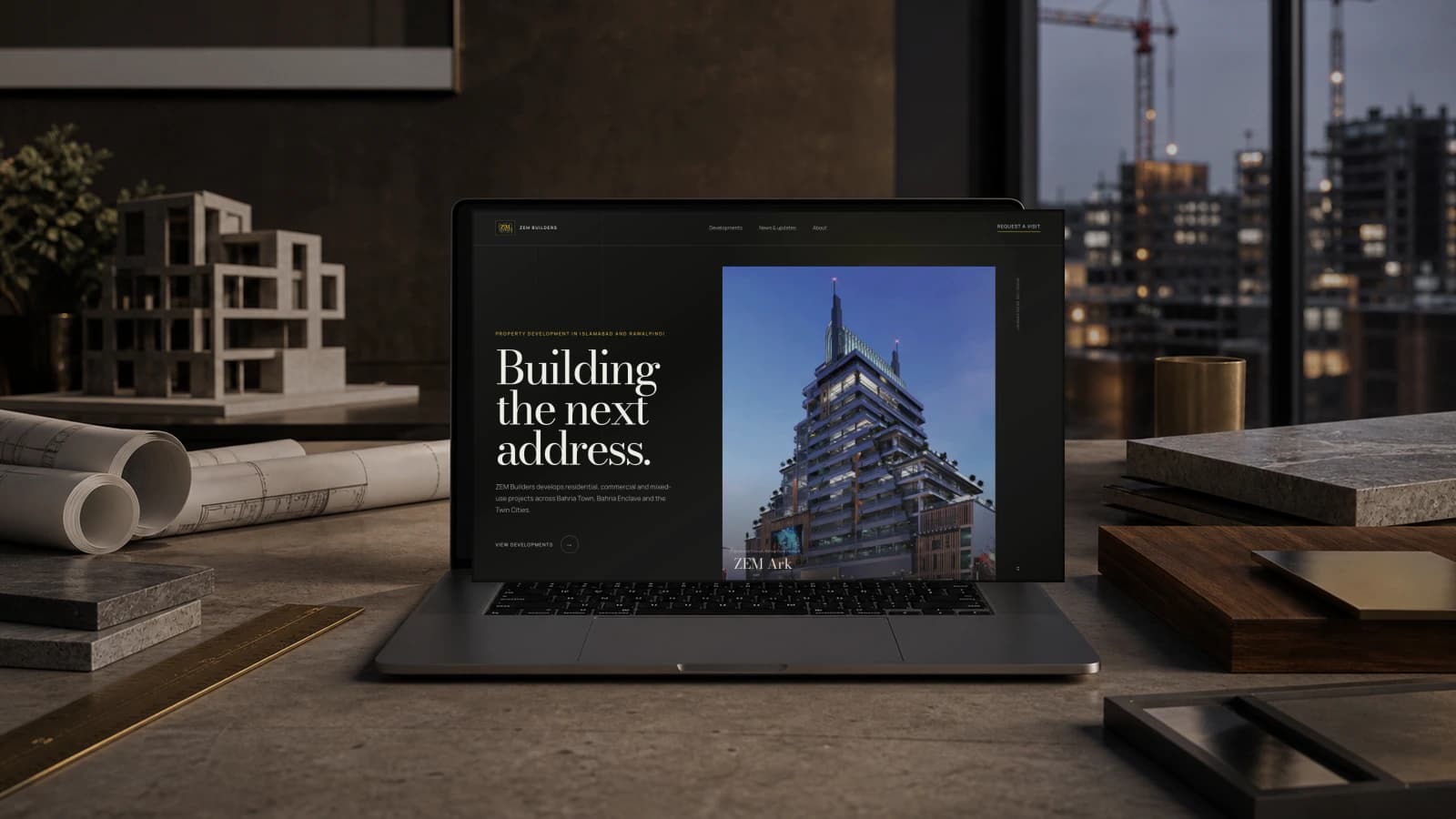
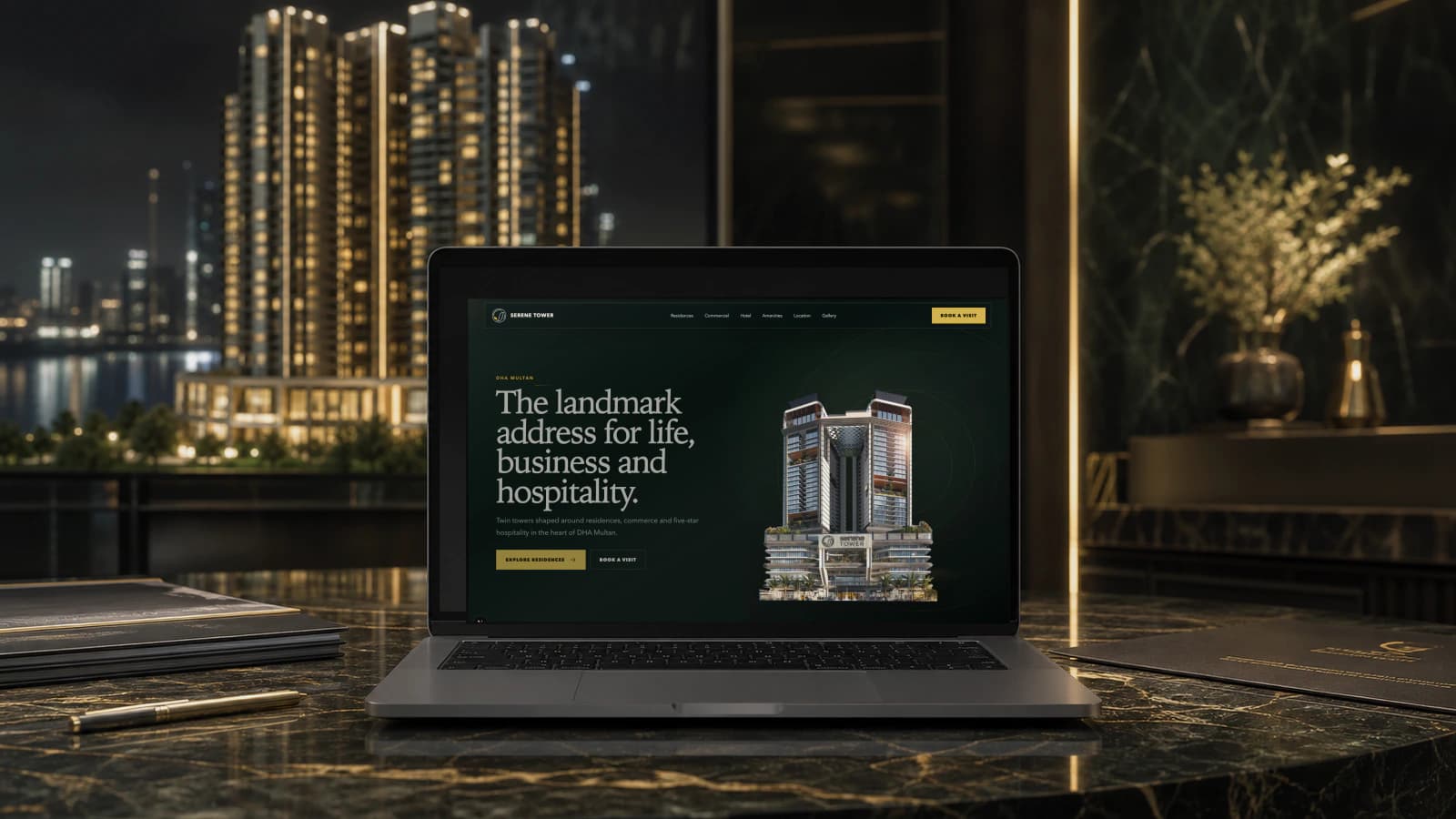
This is where our Pakistani client work sits. 360 The Residences, ZEM Builders and Serene Tower in DHA Multan were built for Pakistani developers, and each is organised around evidence: a scroll-led construction story with verified development information, a project atlas with construction proof, and residence journeys that end in an enquiry. If your booking form asks for CNIC numbers, handle them with care. Section 16 of the Prevention of Electronic Crimes Act 2016 makes it an offence to obtain or transmit another person's identity information without authorisation, so we keep those fields minimal, explain why they are needed and route them securely.
Language, privacy and accessibility in a capital brief
Urdu is the national language, and Article 251 of the Constitution still allows English for official purposes, so English-first is a sound default for most business briefs. Urdu pages earn their place when you sell to consumers, recruit locally or publish public information. Urdu runs right to left and is normally set in Nastaliq, a calligraphic style that needs careful font choice and generous line spacing to read well on screen. We plan mirrored layouts, navigation and font testing from the first wireframe, and the same right-to-left engineering carries Arabic for firms selling into the Gulf.
Privacy rules are still sectoral. Parliament had not passed the Personal Data Protection Bill 2023 as of March 2026, so for most businesses the live obligations sit in PECA and in sector rules such as banking law. The draft bill would limit transfers of some personal data abroad, so we record where form submissions, CRM records and backups are stored, keep consent wording plain, and write privacy notices that can be revised if the law changes.
Accessibility has a capital-specific hook. The ICT Rights of Persons with Disability Act 2020 extends to the Islamabad Capital Territory, and section 15(5) directs the government to ensure that websites hosted by Pakistani website service providers are accessible to persons with disabilities. No Pakistani statute names a technical standard, so we use WCAG as the reference in QA: keyboard access, visible focus, labelled forms, contrast and alternative text.
Payments and tax shape the checkout
Checkout themes and plugins that assume Stripe need replacing here, because Stripe's availability list does not include Pakistan. State Bank figures for October to December 2025 showed digital channels carrying the large majority of retail transactions, mostly through mobile apps, with Raast, the central bank's instant payment system, in wide use. JazzCash, for example, runs an online payment gateway that accepts JazzCash mobile-account and voucher payments, and offers QR and Raast acceptance alongside it. Cash on delivery is still a common expectation among online shoppers, so design for it from the start rather than bolting it on.
Tax now sits inside that choice. Since the Finance Act 2025, payment intermediaries and couriers collect tax on payments for goods and services ordered online: 1% when the buyer pays digitally and 2% when a courier collects cash on delivery, rates the Finance Act 2026 left in place. The 2025 Act also empowered the Federal Board of Revenue to bring service providers under Islamabad's services-tax ordinance onto its systems for real-time reporting, from dates it sets by general order. If your business is in scope, order and invoice data from the site has to fit, so we agree the fields with your accountant before checkout is designed.
One more item belongs in every Islamabad brief: ownership. PKNIC administers .pk domains, and .com.pk is intended for commercial entities registered in Pakistan. Whichever domain you choose, the registrant account, DNS and hosting should be held by your business, not by whoever built the site.
Working across time zones.
Islamabad and Rawalpindi share our clock, so every call, design review and launch check sits inside your normal working day with nothing to convert.
Islamabad, Rawalpindi and Xsofty all run on Pakistan Standard Time (Asia/Karachi, UTC+5), and Pakistan has not observed daylight saving since 2009, so the offset is zero all year. A 10:00 discovery call in Rawalpindi is 10:00 in Islamabad, and a 16:00 launch check is 16:00 on both sides; every hour of a 09:00 to 17:00 local working day maps to the same hour for us.
What a build in Islamabad needs.
Registration and approvals on property pages
The Islamabad Real Estate (Regulation and Development) Act 2020 bars developers from advertising a project before registering it with the Real Estate Regulatory Authority, and requires advertisements and prospectuses to show the registration number and the Authority's website address. The CDA and RDA also publish or announce schemes operating without approval or an NOC. We give registration, approving authority, NOC and layout plan status a fixed place on project pages, next to dated construction progress, with wording confirmed by your legal adviser.
English first, Urdu done properly
Article 251 makes Urdu the national language while allowing English for official purposes. Urdu is right to left and normally set in Nastaliq, so bilingual sites need mirrored layouts, a tested Nastaliq web font and correct language and direction attributes. Xsofty delivers multilingual right-to-left sites, including Urdu and Arabic alongside English, and agrees in the scope who writes or translates each language.
Privacy while the data bill is pending
There is no comprehensive data protection act in force; the Personal Data Protection Bill 2023 was still unenacted as of March 2026, and section 16 of PECA 2016 penalises obtaining or transmitting another person's identity information without authorisation. We minimise form fields, handle CNIC data with care, document where submissions and backups are stored, and write privacy notices that can be updated if the bill passes with its proposed limits on transferring certain personal data abroad.
Accessibility under the ICT disability act
The ICT Rights of Persons with Disability Act 2020 applies to the Islamabad Capital Territory, and section 15(5) directs the government to ensure websites hosted by Pakistani website service providers are accessible. No statute names a technical standard, so Xsofty uses WCAG as the QA reference: keyboard operation, visible focus, labelled forms, colour contrast and alternative text.
Local payment rails and e-commerce tax
Stripe's availability list does not include Pakistan, so stores use local gateways, wallets, Raast and cash on delivery. Payment intermediaries and couriers collect tax on online orders at 1% for digital payment and 2% for cash on delivery, and the FBR has power to bring Islamabad service providers onto real-time reporting by general order. We design checkout and order data with those rules in view and confirm the details with your accountant.
What Xsofty can build for Islamabad clients.
Web Design & Development
High-performance websites shaped around your brand, your audience, and the outcomes that matter.
- Strategy
- Next.js
- CMS
E-Commerce Development
Fast, frictionless storefronts that turn discovery into purchase across every screen.
- Shopify
- WooCommerce
- Conversion
Custom Web Apps & AI Integrations
Purpose-built platforms and useful AI workflows that remove friction from complex operations.
- Web apps
- Automation
- AI
SaaS & Product Development
Multi-tenant web products with subscriptions, roles, billing, and the dashboards customers use every day.
- Multi-tenant
- Subscriptions
- Dashboards
Mobile App Development
iOS and Android apps built alongside the web app and API behind them, so every screen works from the same data.
- iOS
- Android
- APIs
SEO & Digital Growth
Search foundations, content direction, and measurable improvements designed to compound over time.
- Technical SEO
- Content
- Analytics
Website Maintenance & Care Plans
Proactive updates, monitoring, and support that keep your digital presence secure and performing.
- Support
- Security
- Performance
Google Workspace & Business Email
Business email on your own domain, with the accounts, DNS records, and move from your old provider handled.
- Business email
- DNS
- Migration
Who we build for in Islamabad.
IT and software exporters
A site that works as due diligence for foreign buyers: specific service pages, case studies with honest scope, named leadership, careers pages for local hiring, and fast, well-structured pages that read well abroad.
Real estate developers and housing schemes
Project pages that show Real Estate Regulatory Authority registration, CDA approval and NOC status, dated construction progress, unit and amenity detail, and enquiry routing to a named sales team, with Urdu versions where buyers need them.
Consultancies and organisations working with embassies and international partners
English-first, accessible sites with document libraries, clear team and governance pages, and forms that collect only the data the organisation needs.
Education and training providers
Programme and admissions pages that parents and students can scan on a phone, Urdu content for local audiences, and application or enquiry forms that reach the right office.
Retail and consumer brands
Stores with wallet, card, Raast and cash-on-delivery options, order data that fits the e-commerce withholding rules, and a catalogue a small team can manage day to day.
Relevant work
The Pakistani client work in our portfolio is in real estate (360 The Residences, ZEM Builders and Serene Tower in DHA Multan), and Docusafe is shown as relevant technology-sector work rather than as local client work.


In our clients’ own words.
1 of 3
Working with Hamza was straightforward from the beginning. He listened carefully, explained the thinking behind the design, and kept the website focused on what buyers actually need to see. The final result gives 360 The Residences a much stronger and more professional digital presence.
Questions from Islamabad clients.
It removes the time difference. We work on the same clock as Islamabad and Rawalpindi, so discovery calls, design reviews and launch checks sit inside your working day, and decisions are written up after each session. The process is the one we use with every client; if a face-to-face session matters to your team, raise it at discovery.
More in Pakistan
Further reading
- How to choose a web design agency in Islamabad
A practical checklist for choosing a web design agency in Islamabad without being distracted by surface-level portfolios or vague promises.
Sources for this page (22)
- Islamabad is the hub of governmental activity while Rawalpindi is the centre of industrial, commercial and military activity; Islamabad has more than twenty universities; its Software Technology Parks house national and foreign IT companies en.wikipedia.org (opens in a new tab)
- Rawalpindi is a major logistics and transportation centre for northern Pakistan, and its suburban housing developments serve as bedroom communities for workers in Islamabad en.wikipedia.org (opens in a new tab)
- The Diplomatic Enclave in Islamabad houses 43 embassies and high commissions (stated on the page as dozens) en.wikipedia.org (opens in a new tab)
- The Islamabad Technology Park (Chak Shahzad) is a flagship project of the Ministry of IT and PSEB for IT-enabled services, software development, R&D and incubation stza.gov.pk (opens in a new tab)
- CDA lists housing schemes selling or marketing plots without CDA approval or NOC; schemes need layout plan approval and then an NOC before development and plot sales cda.gov.pk (opens in a new tab)
- RDA identified 157 housing schemes as illegal and warned that many use misleading marketing tactics profit.pakistantoday.com.pk (opens in a new tab)
- Islamabad Real Estate (Regulation and Development) Act 2020 (Act I of 2021): extends to ICT; section 3(1) bars advertising, marketing or selling a project without registering it with the Real Estate Regulatory Authority; section 11(2) requires advertisements and prospectuses to show the Authority's website address and the registration number; advertisement includes publicity in any form pakistancode.gov.pk (opens in a new tab)
- Pakistan has not enacted a specific data protection law; PECA 2016 section 16 penalises obtaining, transmitting or using another person's identity information without authorisation dlapiperdataprotection.com (opens in a new tab)
- The Personal Data Protection Bill 2023 had completed consultation but not passed both houses of Parliament (guide updated March 2026); current privacy rules are sectoral (PECA, banking law, credit bureaus, PTA); the draft bill restricts cross-border transfer of critical and sensitive personal data practiceguides.chambers.com (opens in a new tab)
- The ICT Rights of Persons with Disability Act 2020 extends to the Islamabad Capital Territory; section 15(5) states the government shall ensure all websites hosted by Pakistani website service providers are accessible for persons with disabilities lpr.adb.org (opens in a new tab)
- No current Pakistani statute explicitly references WCAG or any other technical accessibility standard nation.com.pk (opens in a new tab)
- Article 251: Urdu is the national language and English may be used for official purposes until arrangements are made for its replacement pakistani.org (opens in a new tab)
- Urdu is written right to left, typically in the calligraphic Nastaliq script, whose letter forms add complexity to typesetting en.wikipedia.org (opens in a new tab)
- Pakistan Standard Time is UTC+5 (Asia/Karachi) and daylight saving time was last observed in 2009 en.wikipedia.org (opens in a new tab)
- Stripe's global availability list does not include Pakistan stripe.com (opens in a new tab)
- SBP data for Q2 FY26 (October to December 2025): digital channels were 92% of retail transactions, mobile apps 83% of digital volume, Raast processed 645.7 million transactions profit.pakistantoday.com.pk (opens in a new tab)
- The JazzCash payment gateway accepts JazzCash mobile-account and voucher payments jazzcash.com.pk (opens in a new tab)
- JazzCash offers merchants QR / Raast payment acceptance alongside its payment gateway jazzcash.com.pk (opens in a new tab)
- Cash on delivery remains widely chosen by Pakistani online shoppers, largely for trust reasons xpay.postexglobal.com (opens in a new tab)
- Finance Act 2025: tax on payments for digitally ordered goods or services at 1% (digital payment via payment intermediary) and 2% (cash on delivery via courier); FBR empowered to integrate service providers under the ICT Tax on Services Ordinance 2001 for real-time reporting from dates set by general order assets.kpmg.com (opens in a new tab)
- Finance Act 2026 (effective 1 July 2026) retains section 6A rates of 1% for digital payment and 2% for cash on delivery assets.kpmg.com (opens in a new tab)
- PKNIC administers .pk domains; .com.pk is designated for commercial entities registered in Pakistan en.wikipedia.org (opens in a new tab)