Arabic-first websites for Saudi businesses

Saudi Arabia
Delivered remotely from Islamabad, Pakistan
Arabic is the primary build, not a translation pass
Saudi Arabia's Basic Law of Governance names Arabic as the language of the Kingdom. For a Saudi-facing business, that makes the Arabic site a first-class product, with English beside it for partners, investors and staff who don't read Arabic. It should not be an English site with a translated copy attached late in the project.
Right-to-left delivery involves more than flipping text direction. Navigation, sliders, progress steps and directional icons mirror. English brand names, SKUs and phone numbers sit inside Arabic sentences without scrambling. Arabic type has to stay readable at small mobile sizes, and forms must accept and validate Arabic input. We build both language versions from one design system, so a new section or product appears in both without a second build.
Search follows the same logic. Google recommends a separate URL for each language version, rather than switching language through cookies or browser settings, and hreflang annotations that tell it which pages are versions of each other. That lets the Arabic and English pages each reach people searching in that language. We set this up before launch instead of retrofitting it later.
Design reviews start on a phone. The Communications, Space and Technology Commission's Saudi Internet Report 2024 found that mobile phones accounted for 99.4% of internet use, with usage peaking between 9 pm and 11 pm. We test the Arabic mobile layout first, and we schedule releases for the Riyadh morning rather than that evening peak.
Checkout and delivery on Saudi terms
mada, the national electronic payment system, added e-commerce and Apple Pay payments in 2018. Online use has grown quickly since: Saudi Central Bank (SAMA) data reported by Arab News put e-commerce spending on mada cards at SR29.86 billion in July 2025, up about 79% on a year earlier. The CST's internet report also found that 93.1% of online shopping happened on local websites. Saudi shoppers mostly buy from local stores, so a checkout should present mada and Apple Pay as primary options, not afterthoughts behind international card logos.
Instalment payments sit inside the same regulated system. SAMA licenses buy-now-pay-later providers: Tamara received its permit in 2023 and Tabby Finance its licence in November 2025. SAMA also publishes a list of licensed payment service providers. Before integration starts, we check your payment gateway against that list and your instalment provider against SAMA's licensing announcements.
Delivery details deserve the same attention. Saudi Post's National Address gives each building a building number, street, secondary number, district, five-digit postal code and city, plus a short address of four letters and four numbers. Saudi Post says using the address speeds up deliveries without extra calls to the recipient, so we design checkout address fields around it in both languages.
Where our work carries over, and what changes
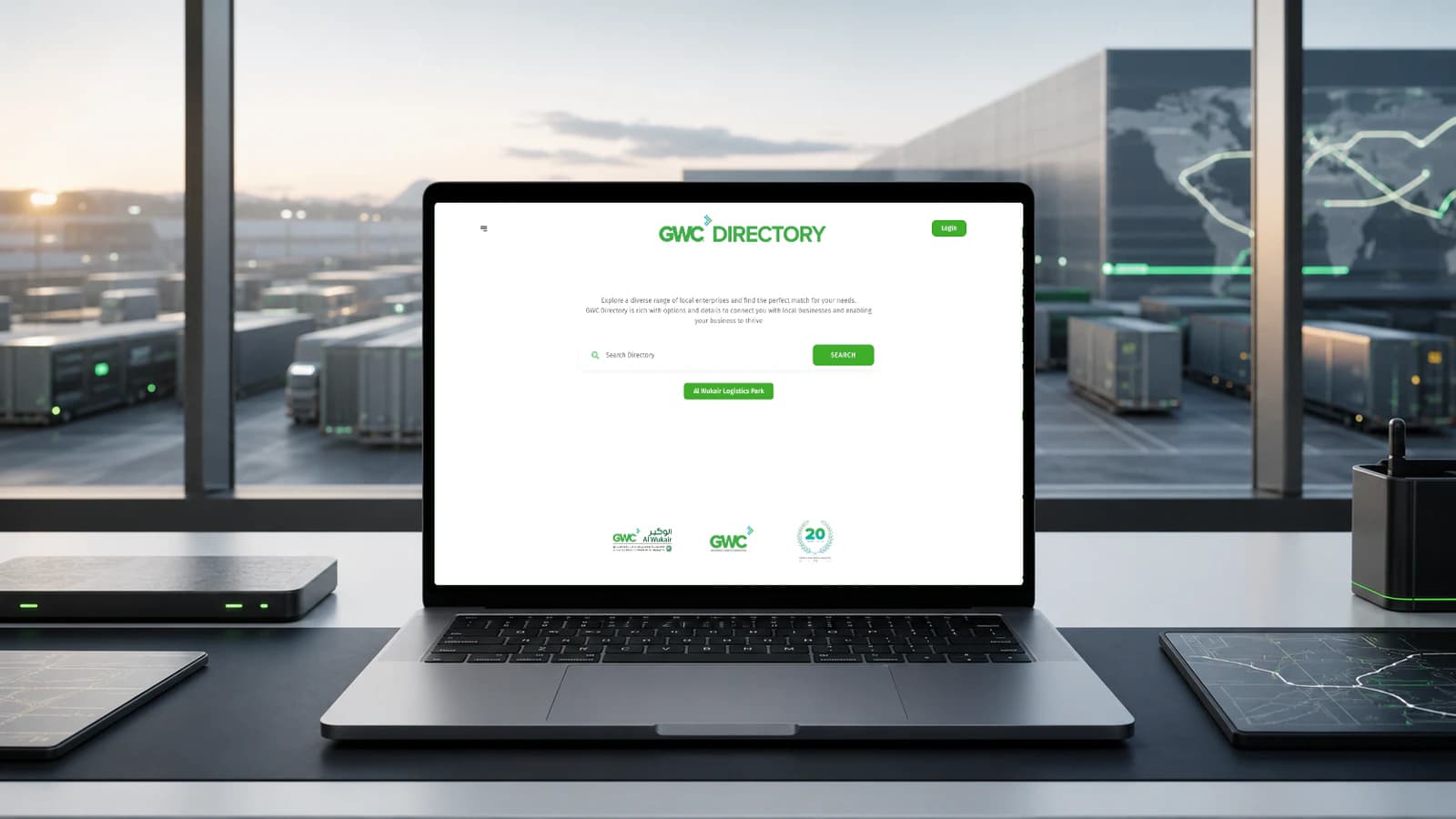
The Gulf client work we show is in Qatar, and we present it that way. The Closet is a fashion storefront that brings a broad catalogue into a focused shopping path that stays direct on any device. GWC Directory makes a large logistics ecosystem searchable without the interface becoming dense. Saudi retailers and logistics firms face the same problem: a lot of content that still has to be easy to scan on a phone.
Logistics is a national priority. Transforming the Kingdom into a logistics hub is one of the four pillars of the National Transport and Logistics Strategy published by the Ministry of Transport and Logistic Services. For carriers, forwarders and industrial suppliers, that can call for bilingual directories, partner profiles and quote-request tools rather than another brochure site. The directory and discovery patterns behind GWC Directory are the closest match in our work.
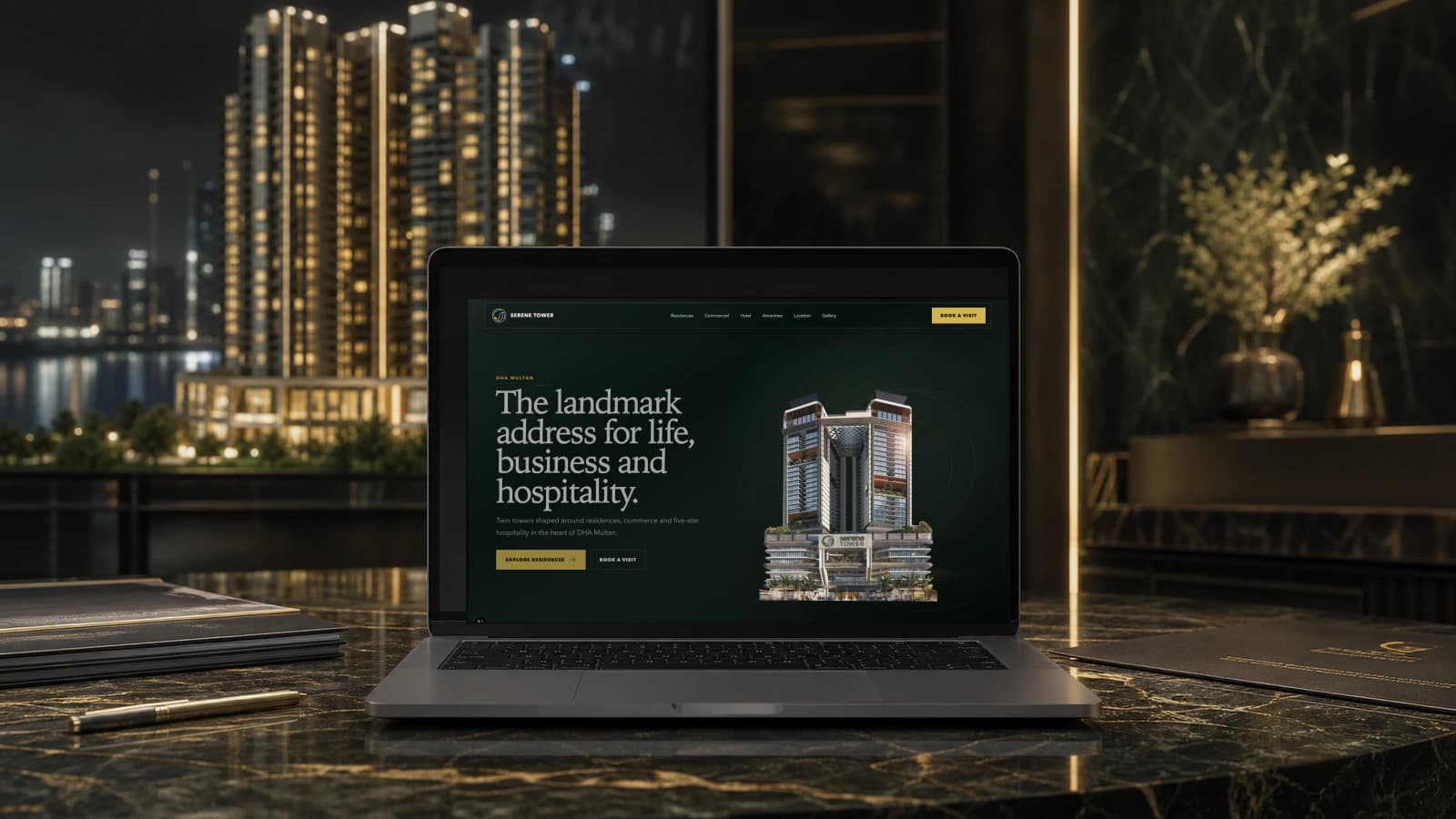
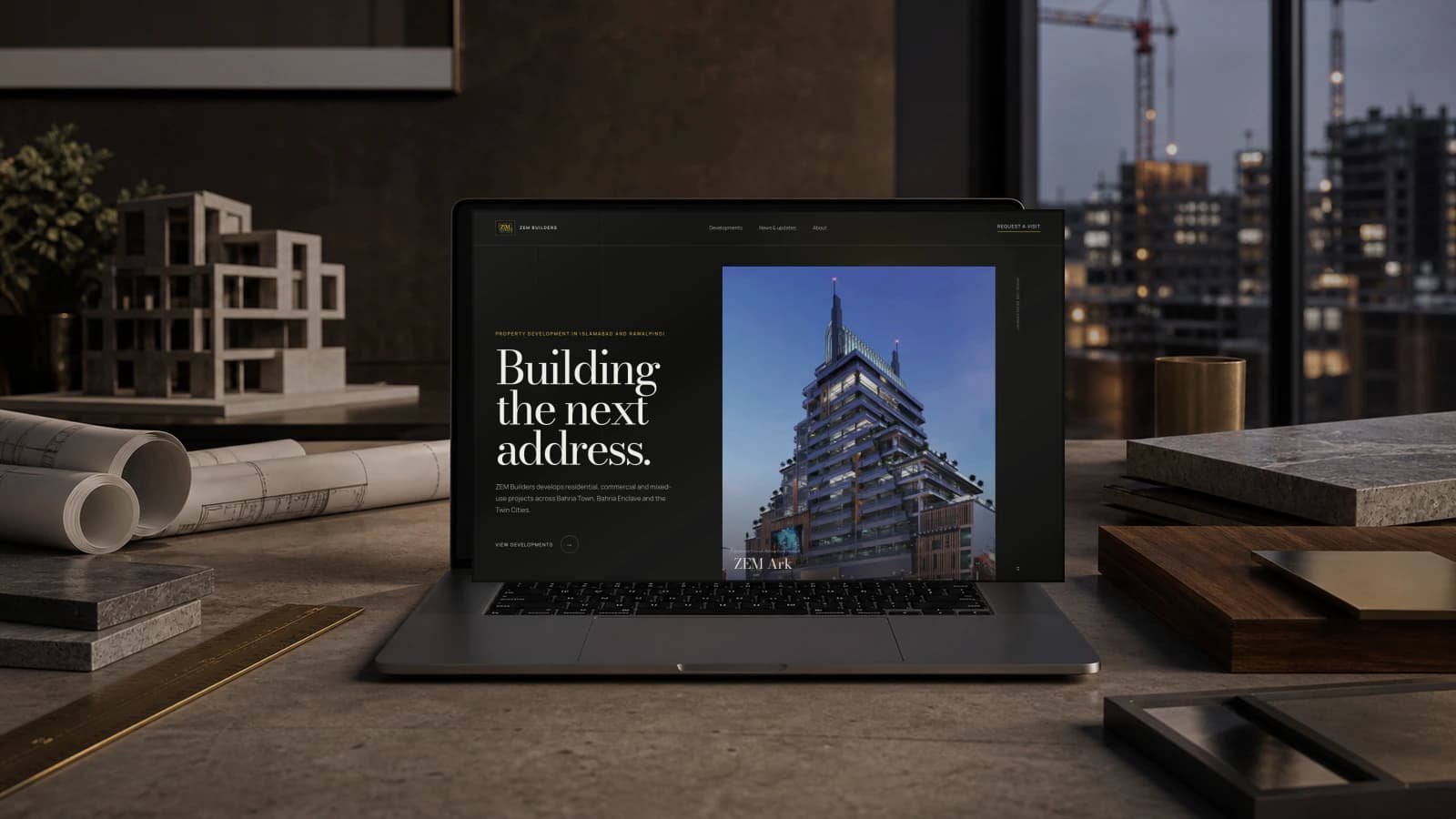
Our real estate launches, 360 The Residences, ZEM Builders and Serene Tower in DHA Multan, were built for Pakistani developers. The structure transfers: project storytelling, unit journeys, construction progress and enquiry routing. The regulation does not. The Real Estate General Authority (REGA) licenses property advertising, including on digital platforms and social media, and an advert's validity can be checked by its licence number through REGA's inquiry service. We give each listing template a field for that number, so buyers can verify a property advert against REGA's records.
Running the project across a two-hour gap
Riyadh is two hours behind Islamabad all year, so a 10:00 review in Riyadh starts at noon in Islamabad. The Saudi week runs Sunday to Thursday with a Friday and Saturday weekend, so we fix review days at kick-off instead of assuming a shared Monday start. During Ramadan, the Labor Law limits working hours for Muslim employees to six a day, so we agree a shorter approval schedule in advance and the launch date doesn't slip.
A project moves through discovery, a bilingual page and content plan, design in both reading directions, a staging build you can review in Arabic and English, and launch checks on redirects, forms, payments and tracking. Decisions are recorded in writing, so an approval given in a Riyadh call is not lost between time zones. After launch, Essential Care at USD 39 a month covers updates, backups and monitoring. Small content edits start with Business Care at USD 79, and stores with mada or instalment checkouts fit Commerce Care at USD 149, which adds checkout and payment-flow checks.
Working across time zones.
Riyadh runs two hours behind Islamabad all year, so review calls fit inside the Saudi working day without anyone joining at night.
Riyadh (UTC+3) and Islamabad (UTC+5) are two hours apart, and neither observes daylight saving, so the gap never changes. Riyadh 9:00 to 17:00 is 11:00 to 19:00 in Islamabad. Riyadh mornings from 9:00 to 13:00 map to 11:00 to 15:00 in Islamabad, the easiest window for live design reviews; a 16:00 Riyadh call is 18:00 in Islamabad. The Saudi working week is Sunday to Thursday, with Friday and Saturday off, so review days are agreed at kick-off. During Ramadan, Article 98 of the Labor Law caps working hours for Muslim employees at six a day (36 a week), and we set a revised review schedule in advance.
What a build in Saudi needs.
Personal Data Protection Law (PDPL)
The PDPL came into force on 14 September 2023 and has been fully enforceable since the one-year grace period ended on 14 September 2024. It also covers entities outside the Kingdom that process data about people living there. It expects a clear privacy policy, a lawful basis such as consent, safeguards for transfers abroad and breach notification to SDAIA within 72 hours, and fines for general violations can reach SAR 5 million. We map what every form, analytics tag and third-party script collects, build consent capture where consent is your lawful basis, and give the privacy notice a proper place in both languages for your adviser to finalise. Because we work from Pakistan, our access to live customer data is part of your transfer picture, so we limit it to what each task needs and use test data on staging.
E-Commerce Law disclosures and returns
The 2019 E-Commerce Law requires an online store to show its name, address, contact methods and commercial registration number, to state the total price including delivery and taxes before purchase, and to issue an invoice afterwards. Consumers generally have seven days to return a product they have not used, with exceptions such as custom-made products. We build these into the footer, product, checkout and policy templates in Arabic and English, so the disclosures stay correct as products and prices change.
ZATCA e-invoicing (FATOORA)
ZATCA's e-invoicing rules have applied to resident VAT taxpayers since 4 December 2021, and the integration phase has rolled out in waves since 1 January 2023. Simplified tax invoices, the kind issued to consumers, need a QR code generated by the taxpayer's e-invoicing solution to ZATCA's specifications. A storefront email template is not that solution, so we plan how orders pass to the compliant accounting or ERP system you use and test that handoff before launch.
Accessibility in both reading directions
Article 14 of Saudi Arabia's 2023 Rights of Persons with Disabilities Law gives people with disabilities the right to access and benefit from written, visual and audio content, and the Digital Government Authority holds government websites to WCAG 2.1 AA. We use WCAG 2.1 AA as the working target on both the Arabic and English versions: correct language and direction attributes, keyboard access, visible focus, sufficient contrast and labelled forms.
What Xsofty can build for Saudi clients.
Web Design & Development
High-performance websites shaped around your brand, your audience, and the outcomes that matter.
- Strategy
- Next.js
- CMS
Arabic & Multilingual Websites
Right-to-left Arabic layouts and bilingual websites, planned for reading and for search in each language.
- Arabic RTL
- Bilingual
- hreflang
E-Commerce Development
Fast, frictionless storefronts that turn discovery into purchase across every screen.
- Shopify
- WooCommerce
- Conversion
Custom Web Apps & AI Integrations
Purpose-built platforms and useful AI workflows that remove friction from complex operations.
- Web apps
- Automation
- AI
Mobile App Development
iOS and Android apps built alongside the web app and API behind them, so every screen works from the same data.
- iOS
- Android
- APIs
SEO & Digital Growth
Search foundations, content direction, and measurable improvements designed to compound over time.
- Technical SEO
- Content
- Analytics
Website Maintenance & Care Plans
Proactive updates, monitoring, and support that keep your digital presence secure and performing.
- Support
- Security
- Performance
Who we build for in Saudi.
Retail and fashion e-commerce
An Arabic-first mobile storefront with mada, Apple Pay and SAMA-licensed instalment options at checkout, E-Commerce Law disclosures in both languages, National Address fields, and orders that pass cleanly into a ZATCA-compliant invoicing system.
Real estate developers and brokers
Project launch sites and unit journeys in Arabic and English, enquiry routing to the sales team, and listing templates with a field for each property's REGA advertisement licence number.
Logistics, freight and industrial suppliers
Searchable bilingual directories, partner and supplier profiles, quote-request flows and portals that stay usable as listings and categories grow.
Architecture, interiors and contracting
Portfolio-led sites where project imagery carries the argument, with bilingual project pages and a direct route to a consultation request.
Professional and technology services
Clear bilingual service pages, PDPL-aware enquiry forms routed to the right inbox or CRM, and a CMS the team can update without a developer.
Relevant work
The Gulf projects on this page are for Qatar clients (The Closet and GWC Directory), and our real estate launches were built for Pakistani developers, shown here for their structure rather than as Saudi projects.


Questions from Saudi clients.
No. Xsofty is based in Islamabad, Pakistan, and runs Saudi projects remotely. Discovery calls and design reviews are scheduled in Riyadh working hours, and decisions are recorded in writing so nothing depends on being in the same room.
Cities we work with in Saudi
Sources for this page (26)
- Article 1 of the Basic Law of Governance states that the Kingdom's language is Arabic. en.wikisource.org (opens in a new tab)
- CST's Saudi Internet Report 2024: mobile phones were the most used devices for browsing (99.4% of usage), peak usage hours were 9 pm to 11 pm, and 93.1% of online shopping occurs on local websites. cst.gov.sa (opens in a new tab)
- Google recommends using different URLs for each language version rather than cookies or browser settings. developers.google.com (opens in a new tab)
- Google recommends hreflang annotations to indicate localized variations of a page. developers.google.com (opens in a new tab)
- mada is the national electronic payment system in Saudi Arabia; mada for e-commerce and Apple Pay payments launched in 2018. saudipedia.com (opens in a new tab)
- SAMA data: e-commerce spending via mada cards reached SR29.86 billion in July 2025, up 79.45% year on year. arabnews.com (opens in a new tab)
- SAMA granted Tamara a buy-now-pay-later (postpaid payment) permit in July 2023. arabnews.com (opens in a new tab)
- SAMA licensed Tabby Finance to engage in buy-now-pay-later activity (10 November 2025). sama.gov.sa (opens in a new tab)
- SAMA publishes a page listing licensed payment service provider companies. sama.gov.sa (opens in a new tab)
- Saudi Post National Address components (building number, street, secondary number, district, 5-digit postal code, city), a short address of 4 letters and 4 numbers, and faster shipment delivery without further calls. splonline.com.sa (opens in a new tab)
- 'Transform KSA into a logistics hub' is one of the four pillars of the National Transport and Logistics Strategy. mot.gov.sa (opens in a new tab)
- REGA's FAL real estate advertising licence covers electronic advertising on digital platforms and social media. rega.gov.sa (opens in a new tab)
- REGA issues real estate advertisement licences through its platform for use across advertising channels and platforms. rega.gov.sa (opens in a new tab)
- REGA's inquiry service lets users verify a real estate advertisement's validity using its licence number. rega.gov.sa (opens in a new tab)
- The Saudi working week runs Sunday to Thursday; Friday and Saturday are the official days of rest. lloydsbanktrade.com (opens in a new tab)
- Article 98 of the Labor Law: actual working hours for Muslims during Ramadan do not exceed 6 hours per day or 36 hours per week. hrsd.gov.sa (opens in a new tab)
- Arabia Standard Time is UTC+3 and daylight saving is not observed. en.wikipedia.org (opens in a new tab)
- Pakistan Standard Time is UTC+5 and daylight saving is not currently observed. en.wikipedia.org (opens in a new tab)
- PDPL in force 14 September 2023 with a one-year grace period to 14 September 2024; applies to entities outside KSA processing data of residents; breach notification to SDAIA within 72 hours; fines up to SAR 5 million for general violations. dlapiperdataprotection.com (opens in a new tab)
- PDPL requires a clear and comprehensive privacy policy, lists consent among lawful bases, and requires appropriate safeguards for cross-border transfers. morganlewis.com (opens in a new tab)
- PDPL applies to any entity, regardless of location, processing personal data of individuals residing in Saudi Arabia; transfer safeguards are SCCs, binding corporate rules and certificates of accreditation. clydeco.com (opens in a new tab)
- E-Commerce Law (2019): stores must display name, address, contact methods and CR number; state total price including delivery and taxes; issue an invoice; consumers may return an unused product within seven days, with exceptions including custom-made products. saudipedia.com (opens in a new tab)
- ZATCA e-invoicing Phase One enforced 4 December 2021 for all taxpayers excluding non-residents; Phase Two integration from 1 January 2023 in waves; covers tax invoices (B2B) and simplified tax invoices (B2C). zatca.gov.sa (opens in a new tab)
- Simplified tax invoices require a mandatory QR code generated by the taxpayer's e-invoicing solution based on ZATCA's specifications. zatca.gov.sa (opens in a new tab)
- The 2023 Rights of Persons with Disabilities Law (Article 14) gives persons with disabilities the right to access and benefit from written, visual and audio content. saudipedia.com (opens in a new tab)
- The Digital Government Authority holds government entities to WCAG 2.1 AA as the baseline under its web accessibility guideline. deque.com (opens in a new tab)